
Read the full context, compare alternatives and consider your own circumstances before making a financial decision.
You have ₹1 lakh sitting in your bank account. You don’t need all of it today, but you also don’t want to take unnecessary risks with it.
Should you simply leave the money in your savings account, where it remains available whenever you need it? Or should you move some of it into a fixed deposit (FD) to potentially earn a higher rate of interest?
For many Indian savers, this isn’t really a question of savings account versus fixed deposit. Both can serve useful—but very different—purposes.
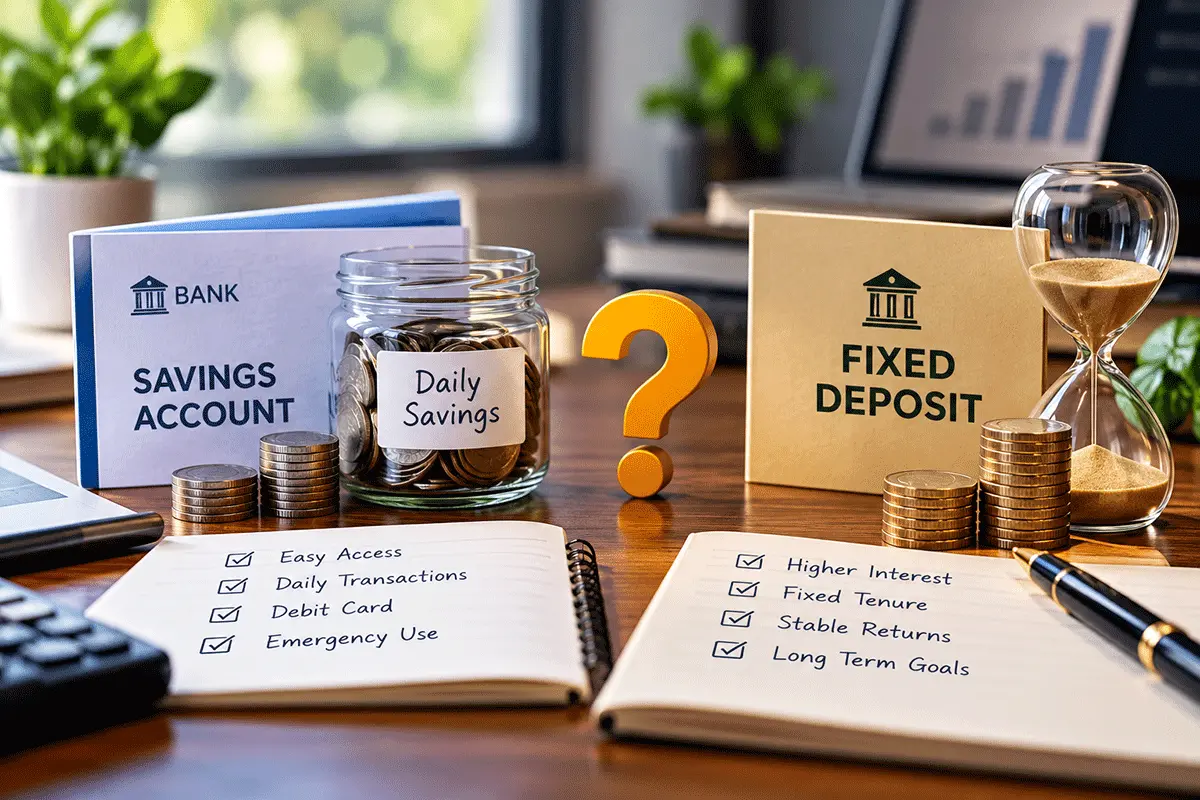
A savings account is primarily designed for access and everyday liquidity. A fixed deposit is designed for money that you can set aside for a defined period in exchange for a predetermined interest rate.
Understanding that difference can help you decide where each part of your money belongs.
Savings Account vs Fixed Deposit: Quick Comparison
| Feature | Savings Account | Fixed Deposit |
|---|---|---|
| Main purpose | Everyday banking and liquid savings | Saving money for a defined period |
| Access to money | Very high | Lower than savings account |
| Interest | Usually lower | Generally higher than savings accounts |
| Rate certainty | Can change | Usually locked for the chosen tenure |
| Tenure | No fixed maturity | Fixed tenure |
| Premature withdrawal | Not applicable in the same way | Usually possible, subject to bank terms/penalty |
| Best suited for | Emergency and near-term money | Money not immediately required |
| Tax on interest | Interest may be taxable subject to applicable rules | Interest may be taxable subject to applicable rules |
| Deposit insurance | Eligible deposits at insured banks are covered subject to DICGC rules | Same |
The simple takeaway: A savings account prioritises liquidity. An FD prioritises predictability and potentially better interest.
What Is a Savings Account?
A savings account is a bank deposit account designed to let you keep money safely while retaining easy access to it.
You can normally use the account for activities such as receiving income, paying bills, making UPI transactions, using a debit card, withdrawing cash and transferring money.
Banks determine their own savings-deposit interest rates under RBI’s regulatory framework, and interest on domestic savings deposits is calculated on the daily end-of-day balance.
That combination of accessibility and interest makes a savings account useful for money that you may need at short notice.
A savings account can be suitable for:
- Monthly household expenses
- Emergency funds
- Upcoming bills and EMIs
- Short-term planned expenses
- Money you may need without advance notice
The main disadvantage is that keeping all your surplus cash in a savings account may mean accepting a lower return than other suitable deposit options.
What Is a Fixed Deposit?
A fixed deposit is a term deposit.
You place a specified amount with a bank for a chosen tenure, and the bank offers an interest rate applicable to that deposit.
RBI permits banks to determine term-deposit rates within the applicable regulatory framework, so FD rates can vary by bank, tenure, deposit amount and product conditions.
This is why an FD shouldn’t be thought of simply as a “better savings account.”
You’re giving up some flexibility in exchange for greater predictability.
An FD may be useful for:
- Money you know you won’t need immediately
- A financial goal with a reasonably known date
- Conservative savings where capital stability is important
- Parking part of your surplus cash for a defined period
- People who prefer predictable returns rather than market-linked returns
Savings Account vs FD: The Important Differences
1. Liquidity
This is arguably the biggest difference.
Money in your savings account is generally available when you need it. You can transfer it, withdraw it or spend it subject to the bank’s normal account and transaction rules.
An FD, by contrast, has a maturity date.
Many bank FDs allow premature withdrawal, but the interest received may be recalculated and/or a penalty may apply according to the bank’s terms. RBI’s framework allows banks to determine applicable premature-withdrawal conditions and rates within regulatory requirements.
Therefore, money you might suddenly need should generally not all be locked into an FD.
MoneyTrendy rule of thumb:
Need it anytime → prioritise liquidity.
Know you won’t need it for a while → consider whether an FD fits the goal.
2. Interest and Returns
FDs will often offer a higher interest rate than ordinary savings accounts, but don’t assume this automatically.
Rates differ between banks and products and can change over time.
Before opening an FD, compare:
- Interest rate
- Tenure
- Premature-withdrawal rules
- Interest payout frequency
- Auto-renewal conditions
- Senior-citizen rates, where applicable
- Tax implications
Don’t select an FD based solely on the largest percentage shown in an advertisement.
3. Predictability
Suppose you open an FD at a specified rate for a particular tenure.
Subject to the product terms, that gives you much more certainty about what the deposit is expected to earn during that tenure.
Savings-account rates, on the other hand, can be changed by the bank.
That makes FDs potentially useful when certainty matters more than immediate access.
4. Emergency Access
Your emergency fund has a different job from your investment portfolio.
Its first job is being available when something goes wrong.
Imagine suddenly facing an urgent medical expense, major home repair or temporary loss of income. The highest interest rate becomes much less important than being able to access the money quickly.
That’s why putting your entire emergency fund into a long-term FD may not be ideal.
A more practical approach can be to keep part immediately accessible in savings and, depending on your circumstances, use shorter deposits or an FD ladder for another portion.
What Is an FD Ladder?
Instead of putting ₹3 lakh into one FD, you could divide it into several deposits with different maturity dates.
For example:
| Deposit | Amount | Example tenure |
|---|---|---|
| FD 1 | ₹1,00,000 | 6 months |
| FD 2 | ₹1,00,000 | 12 months |
| FD 3 | ₹1,00,000 | 18 months |
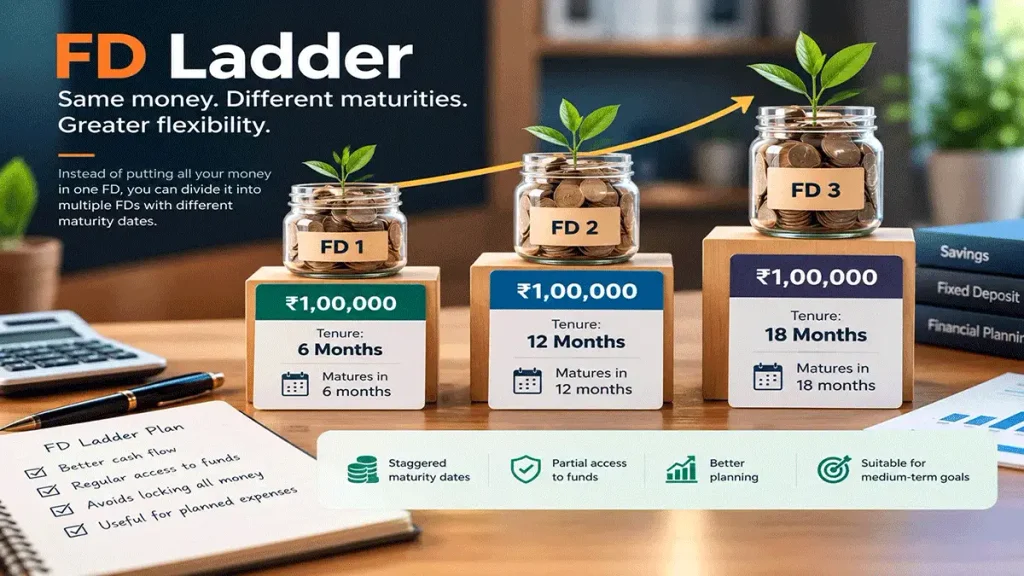
As deposits mature at different times, you periodically regain access to part of your money.
This is commonly called an FD ladder.
It doesn’t eliminate liquidity constraints or premature-withdrawal conditions, but it can avoid having every rupee locked into one maturity date.
Are Savings Accounts and Fixed Deposits Safe?
Eligible savings and fixed deposits with DICGC-insured banks are covered by India’s deposit-insurance system.
DICGC currently provides insurance of up to ₹5 lakh per depositor per bank in the same right and same capacity, including both principal and accrued interest. Deposits across branches of the same bank are aggregated for this purpose.
That distinction matters.
Suppose, in the same capacity at one bank, you have:
Savings account: ₹2 lakh
FD: ₹4 lakh
The combined ₹6 lakh isn’t separately insured simply because it sits in two different products. Subject to DICGC’s rules, deposits in the same right and capacity at that bank are aggregated, with insurance up to the applicable ₹5 lakh limit.
Deposits at different insured banks are treated separately for the insurance limit.
This is an important point when keeping larger cash deposits.
What About Tax?
Interest shouldn’t be compared only on the headline rate.
The after-tax return matters.
Interest earned from bank deposits can have income-tax consequences depending on the type of interest, taxpayer and applicable law. Tax rules and TDS provisions can also change.
For example, the Income Tax Department specifically provides certain deposit-interest provisions for eligible senior citizens.
Rather than choosing between savings and FD purely on the advertised interest rate, consider what you may actually retain after applicable taxes.
For significant amounts or where you’re uncertain about tax treatment, check the current Income Tax rules or consult a qualified tax professional.
So, Where Should You Keep Your Money?
There isn’t one answer for every rupee you own.
A useful way to think about it is to give money different jobs.
Money needed for everyday spending
A savings account generally makes more sense.
You need immediate access for groceries, bills, EMIs, UPI payments and routine expenses.
Money kept for emergencies
Liquidity should remain the priority.
Keeping at least part of your emergency reserve readily accessible can be more important than squeezing out additional interest.
Money not needed for several months
An FD may be worth considering, particularly when you value predictable returns and don’t want market-linked risk for that money.
Money needed on a known future date
An FD whose maturity roughly matches the goal can potentially be useful.
For example, if you expect to need money for an annual insurance premium several months from now, a suitable short-term deposit could be considered rather than leaving every surplus rupee idle.
Money intended for long-term wealth creation
This is where the question changes.
A savings account and FD are deposit products, not necessarily substitutes for long-term investments.
For goals many years away, you may also need to evaluate investments according to your risk tolerance, time horizon and financial circumstances.
A Practical Three-Bucket Approach

Instead of asking:
“Savings account or FD?”
consider dividing your money into buckets.
Bucket 1 — Spend
Money needed for regular expenses.
Possible home: Savings account.
Bucket 2 — Protect
Emergency money and near-term commitments.
Possible home: A combination of liquid savings and suitable short-duration deposits, depending on your needs.
Bucket 3 — Grow
Money intended for longer-term goals.
Possible home: Appropriate investments selected according to your time horizon and risk profile—not automatically a savings account or FD.
This separation prevents one financial product from being forced to perform every job.
Example: You Have ₹2 Lakh in Savings
Suppose someone has ₹2 lakh sitting in a savings account.
Their monthly essential expenses are ₹30,000, and they don’t expect to need the full ₹2 lakh immediately.
Instead of moving the entire amount into an FD simply because the interest rate looks better, they could first ask:
How much do I need immediately?
How large should my emergency reserve be?
Do I have a known expense coming up?
When might I need the remaining money?
Only after answering those questions does comparing deposit products become meaningful.
The correct allocation could be completely different for two people who both have ₹2 lakh.
Common Mistakes to Avoid
Putting your entire emergency fund into a long FD: A financial emergency doesn’t wait for the maturity date.
Keeping every surplus rupee in savings indefinitely: Convenience can sometimes come at the cost of lower returns.
Chasing the highest FD rate without checking the institution: Rate is only one factor. Check the bank, product conditions and applicable deposit-insurance position.
Ignoring premature-withdrawal rules: Know what happens if you need the money before maturity.
Ignoring tax: Compare returns after considering your own tax situation.
Automatically renewing an FD forever: When an FD matures, reconsider your goals instead of assuming the same product remains appropriate.
Savings Account or FD: Which Is Better?
Neither is universally better.
A savings account is generally better for accessibility.
A fixed deposit can be better for money that can remain set aside for a defined period when predictable returns are important.
For many households, the sensible answer isn’t choosing one and rejecting the other.
It’s using both for different purposes.
Your savings account handles liquidity.
Your FD can handle an appropriate portion of money that doesn’t need to remain immediately available.
And money intended for long-term growth should be considered separately according to your financial goals and risk profile.
The MoneyTrendy Takeaway
Don’t ask:
“Which product gives me more interest?”
Ask:
“When will I need this money?”
Once you know the answer, deciding where the money belongs becomes much easier.
Frequently Asked Questions
Is an FD better than a savings account?
Not in every situation. An FD may offer better interest and greater rate certainty, while a savings account provides much easier access to your money. The appropriate choice depends on when you’ll need the funds.
Should I keep my emergency fund in an FD?
You may choose to keep a portion in suitable deposits, but emergency money needs to remain accessible. Avoid locking the entire emergency reserve somewhere that could make urgent access difficult or costly.
Can I withdraw an FD before maturity?
Many FDs permit premature withdrawal, but the bank’s applicable interest and penalty rules can affect what you receive. Check the specific FD terms before depositing.
Are fixed deposits risk-free?
Bank FDs are generally considered low-risk deposit products, but “risk-free” is too broad a description. Among other considerations, eligible deposits at DICGC-insured banks have deposit insurance subject to the applicable ₹5 lakh limit and DICGC rules.
Is ₹5 lakh insurance available separately for my savings account and FD?
Not necessarily. Eligible deposits held in the same right and same capacity across branches of the same insured bank are aggregated for DICGC insurance purposes. The current maximum insurance is ₹5 lakh including principal and interest.
Editorial & financial note
MoneyTrendy content is educational and does not constitute personalised financial, investment, tax or legal advice.