Read the full context, compare alternatives and consider your own circumstances before making a financial decision.
You apply for a personal loan, but the bank offers a higher interest rate than you expected. A friend with a similar income receives a more attractive offer.
Why? One possible reason is the difference between your credit profiles. When banks and other lenders evaluate loan applications, they consider several factors, including income, existing debt, repayment capacity and credit history.
Your CIBIL score is one of the indicators they may use to understand how you have managed credit in the past.
A healthy credit score can strengthen your financial profile. A poor score, on the other hand, may make borrowing more difficult or expensive. But what happens if your score is low? Can you improve it? And how long does it take?
The encouraging part is that credit scores are not necessarily permanent. Your financial behaviour and the accuracy of your credit records can influence your score over time.
This guide explains how to improve your CIBIL score in India, what affects it and ten practical steps that can help you build a healthier credit profile.
What Is a CIBIL Score?
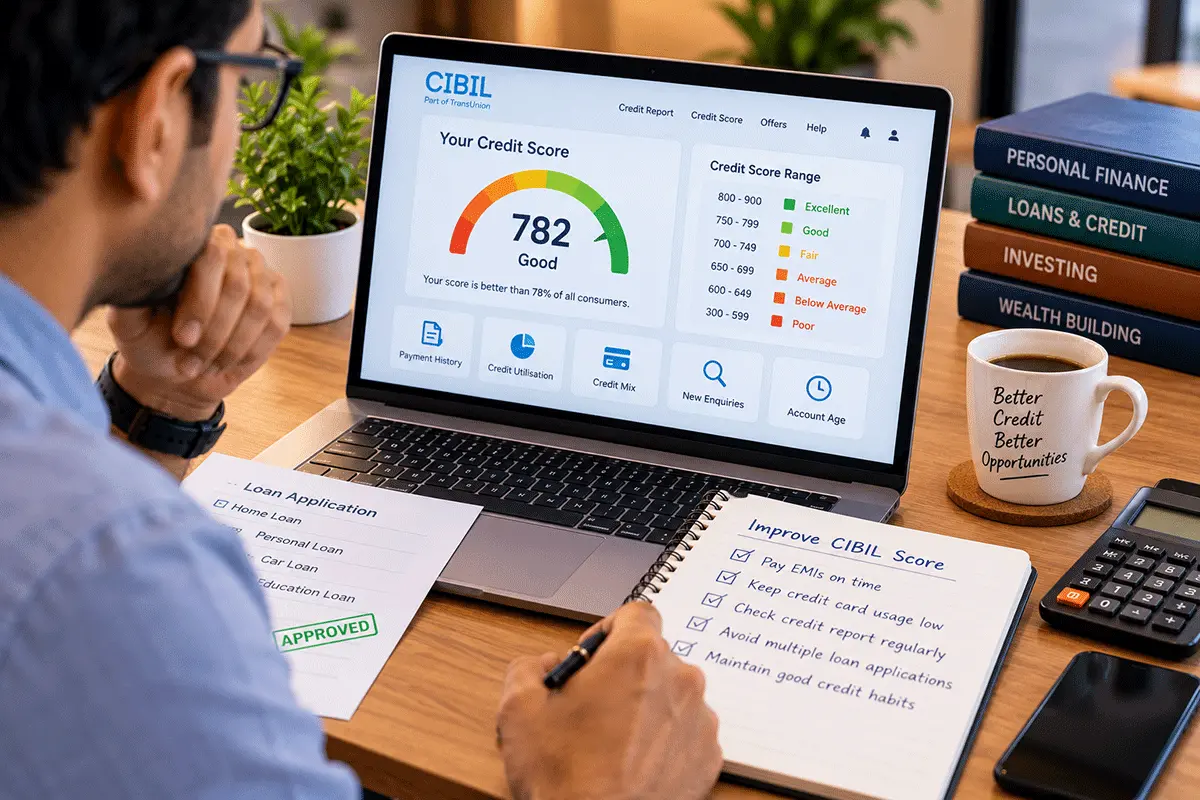
A CIBIL score is a three-digit credit score generated by TransUnion CIBIL, one of India’s credit information companies. It is calculated using information in your credit report, including your borrowing and repayment history.
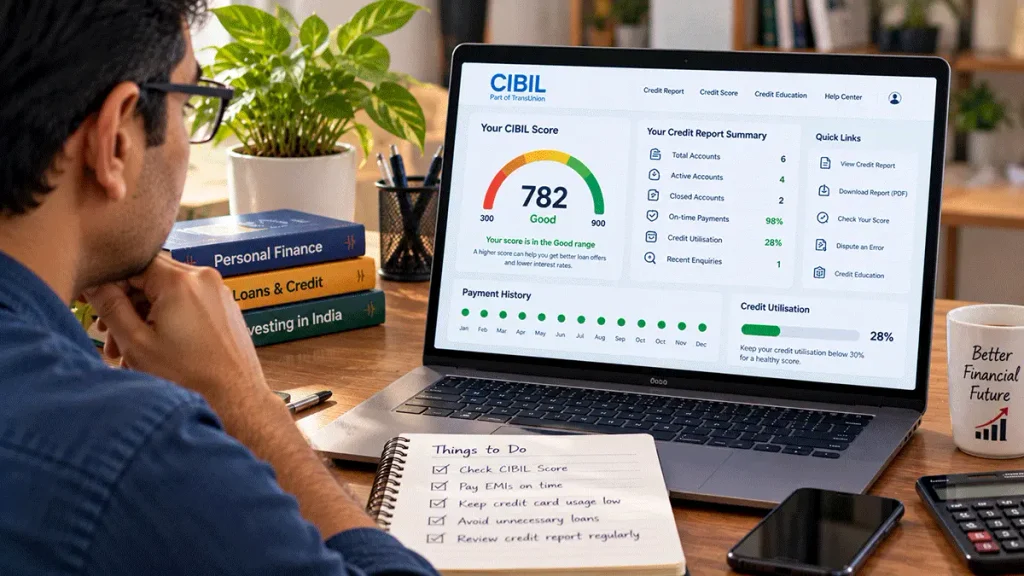
For individuals with sufficient eligible credit history, the commonly used CIBIL score ranges from 300 to 900.
A higher score generally indicates a stronger credit profile according to the scoring model. However, a CIBIL score is not a guarantee that a lender will approve a loan.
Banks and financial institutions also assess income, employment, existing obligations, internal lending policies and other information.
Understanding the CIBIL Score Range
The following ranges are broad educational guidelines, not official universal approval categories.
| CIBIL Score | General Interpretation |
|---|---|
| 300–549 | Very weak credit profile |
| 550–649 | Below-average credit profile |
| 650–699 | Developing or moderate credit profile |
| 700–749 | Relatively healthy credit profile |
| 750–799 | Strong credit profile |
| 800–900 | Very strong credit profile |
Many lenders regard scores around 750 or above favourably, but there is no single minimum CIBIL score that guarantees loan approval. Different lenders use different criteria. Some borrowers may receive credit with lower scores, while applicants with high scores can still be declined for other reasons.
Why Is Your CIBIL Score Important?
Your credit score can influence several aspects of borrowing.
1. Loan Approval
Lenders may use credit scores as part of their risk assessment. A stronger credit profile can support an application, although approval depends on multiple factors.
2. Interest Rates
Some lenders use risk-based pricing. Borrowers with stronger credit profiles may qualify for more competitive interest rates, depending on the product and lender.
3. Credit Card Eligibility
Credit card issuers may review your credit history when deciding whether to approve an application and what credit limit to offer.
4. Loan Amount and Terms
Your credit profile can affect the amount a lender is willing to offer, alongside your income and repayment capacity.
5. Financial Flexibility
Maintaining a healthy credit history can give you more options when you genuinely need to borrow. However, borrowing simply to increase a score is not a sensible financial goal.
What Factors Affect Your CIBIL Score?
Credit scoring models consider multiple elements of your credit history. The precise scoring formula and weightings are proprietary and may change.
Important factors generally include:
- Repayment history.
- Outstanding balances.
- Credit utilisation.
- Age and depth of credit history.
- Types of credit accounts.
- Recent credit applications and enquiries.
- Serious delinquencies or defaults.
- Information reported by lenders.
The effect of any particular factor depends on your overall credit profile. For example, missing several loan payments may have a greater negative effect than using a slightly higher proportion of your credit card limit for one month. Understanding these factors helps you focus on habits that matter.
1. Pay Every EMI and Credit Card Bill on Time
Timely repayment is one of the most important habits for maintaining a healthy credit profile.
Your credit report records information about how you repay loans and credit cards. Late payments can damage your credit history, particularly when they become seriously overdue.
Example
Suppose you have:
- Personal loan EMI: ₹5,000.
- Two-wheeler loan EMI: ₹2,500.
- Credit card bill: ₹4,000.
Your total scheduled monthly payments are ₹11,500. If you repeatedly miss due dates, lenders may report those delays to credit information companies. This can negatively affect your credit profile.
What You Should Do
Maintain a calendar of repayment dates. Where appropriate, set reminders or use reliable automatic payment arrangements. Ensure sufficient funds are available before a scheduled debit.
For credit cards, paying the full statement balance by the due date is generally preferable to paying only the minimum amount, because unpaid revolving balances can attract substantial interest.
Important: Paying the minimum amount may help avoid a payment being treated as overdue when done according to the card’s terms, but it does not prevent interest on unpaid balances or eliminate debt.
If you are already struggling with repayments, prioritise contacting lenders to discuss realistic arrangements rather than taking new expensive loans to cover old ones.
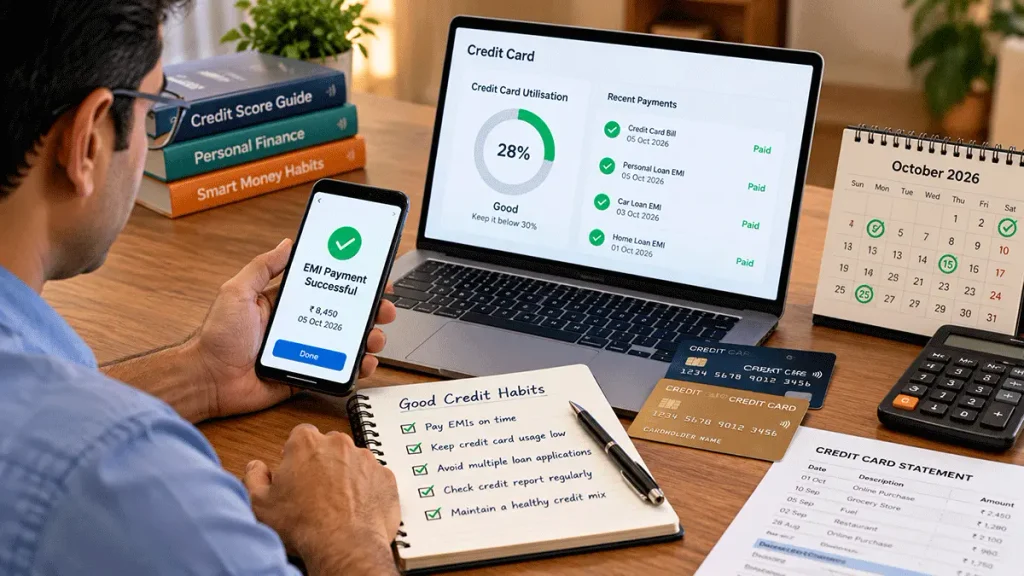
2. Keep Your Credit Card Utilisation Low
Credit utilisation measures how much of your available revolving credit you are using. It is commonly calculated as:
Credit Utilisation Ratio = (Outstanding Credit Card Balance ÷ Total Available Credit Limit) × 100
Example
Suppose your credit card has a limit of ₹1,00,000. If the reported outstanding balance is ₹80,000:
Credit Utilisation = 80%
If the reported balance is ₹25,000:
Credit Utilisation = 25%
| Credit Limit | Reported Balance | Utilisation |
|---|---|---|
| ₹1,00,000 | ₹90,000 | 90% |
| ₹1,00,000 | ₹60,000 | 60% |
| ₹1,00,000 | ₹30,000 | 30% |
| ₹1,00,000 | ₹10,000 | 10% |
High utilisation can indicate greater dependence on revolving credit. Keeping balances manageable may help your credit profile.
Is 30% the Ideal Credit Utilisation Ratio?
You may have heard that utilisation should always remain below 30%. This is a useful general guideline, but 30% is not an official guaranteed scoring threshold.
There is no promise that reducing utilisation to 29% will automatically increase your CIBIL score. A better principle is to avoid consistently using most of your available credit and repay outstanding balances responsibly. Do not spend unnecessarily just to demonstrate credit card activity.
3. Avoid Applying for Multiple Loans and Credit Cards Together
When you apply for a loan or credit card, the lender may request your credit report. Such lender-initiated checks are commonly called hard enquiries. Several applications within a short period can make your credit profile appear more risky.
This does not mean one credit enquiry will necessarily cause a major score reduction. The impact depends on your credit history and the scoring model.
Example
Imagine applying for:
- Three personal loans.
- Two credit cards.
- One consumer durable loan.
All within a few weeks. Even if you do not accept every offer, the lender enquiries may appear in your credit report.
Better Approach
Compare lending products before submitting formal applications. Review eligibility criteria, interest rates, fees and repayment obligations. Apply only when you have a genuine borrowing requirement. Avoid submitting applications to many lenders simply to see which one approves you.
4. Check Your Credit Report Regularly
A credit score summarises your credit profile, but the detailed credit report explains what information lenders have reported.
Reviewing the report can help identify problems such as:
- Incorrect personal information.
- Loans you do not recognise.
- Incorrect outstanding balances.
- Payments wrongly shown as overdue.
- Closed loans still reported as active.
- Duplicate credit accounts.
- Incorrect account status.
How to Get a Free Credit Report in India
Under RBI directions, eligible individuals can obtain one free full credit report, including the credit score, once in a calendar year from each credit information company, subject to the applicable rules.
You can access your TransUnion CIBIL report through its official website:
Other RBI-registered credit information companies also provide credit reports. Be careful when using third-party services that request unnecessary personal information or advertise guaranteed score improvements.
Does Checking Your Own CIBIL Score Reduce It?
Checking your own credit report or score through an authorised consumer-access service is generally treated as a soft enquiry. It does not affect your CIBIL score in the same way as a lender’s hard enquiry. Therefore, you can review your own report without worrying that the act of checking it will damage your score.
5. Dispute Incorrect Information in Your Credit Report
Sometimes, a credit report contains inaccurate or outdated information. For example, you may have fully repaid a loan, but the report still shows an outstanding balance.
Or a payment may be incorrectly marked as overdue. Such errors can affect how lenders assess your creditworthiness.
How to Raise a Dispute
Step 1: Download your latest credit report.
Step 2: Identify the incorrect entry.
Step 3: Collect supporting documents, such as payment receipts, bank statements or loan closure letters.
Step 4: Submit a dispute through the credit information company’s official process.
Step 5: Contact the reporting lender when necessary.
Step 6: Track the dispute and review the corrected report.
Credit information companies generally cannot change lender-reported account information independently without the required verification or confirmation.

How Long Does a Correction Take?
RBI’s credit information reporting framework provides timelines for complaint resolution and, in eligible cases, compensation for delays. However, the outcome depends on the nature of the complaint and the information supplied by the lender. Keep all complaint acknowledgements and supporting documents.
Never pay an agent who promises to remove accurate late payments or defaults from your credit report.
Genuine negative information cannot simply be erased because someone charges a fee.
6. Avoid Closing Old Credit Accounts Without Considering the Impact
The length and depth of your credit history can influence your credit profile. An older account with a good repayment record may provide useful information about your long-term borrowing behaviour. Closing a credit card can also reduce your available credit limit, potentially increasing your overall utilisation ratio.
Example
Suppose you have two credit cards:
| Card | Credit Limit |
|---|---|
| Card A | ₹1,00,000 |
| Card B | ₹50,000 |
| Total | ₹1,50,000 |
Your combined reported balance is ₹30,000.
Your overall utilisation is:
₹30,000 ÷ ₹1,50,000 × 100 = 20%
If you close Card B and the same ₹30,000 balance remains on Card A, your utilisation becomes:
₹30,000 ÷ ₹1,00,000 × 100 = 30%
This change may affect your credit profile.
Should You Never Close an Old Card?
No. A card with high annual fees, poor terms or a risk of encouraging overspending may not be worth keeping. Your financial well-being matters more than preserving a credit account purely for scoring purposes. Evaluate the costs, benefits and risks before closing an account.
7. Maintain a Responsible Mix of Credit
Credit reports may contain different types of borrowing.
These include:
Secured credit: Loans backed by collateral, such as certain home or vehicle loans.
Unsecured credit: Borrowing without specific collateral, such as personal loans and credit cards.
A history of responsibly managing different credit products can provide lenders with more information about your repayment behaviour. However, this does not mean you should take out unnecessary loans to create a particular credit mix.
A Common Mistake
Some borrowers believe taking several small loans will automatically improve their credit score. In reality, additional borrowing can increase repayment pressure, create more enquiries and raise the risk of missed payments.
Do not borrow money solely to improve your credit score.
Responsible management of existing credit is usually a more sensible starting point.
8. Reduce Outstanding Debt Gradually
High debt obligations can place pressure on your monthly cash flow. Although the CIBIL score does not directly measure every aspect of your income and expenses, outstanding credit balances and repayment history are important parts of your credit profile. Reducing debt can improve financial stability and may help your credit profile over time.
How to Prioritise Repayment
Start by preparing a list of your outstanding obligations.
Record:
- Lender name.
- Outstanding balance.
- Interest rate.
- Monthly payment.
- Due date.
- Overdue status, if any.
Then develop a realistic repayment plan. If all required payments are affordable, you may consider directing extra funds toward higher-interest debt first. This can reduce the overall interest burden.
However, if your debt payments exceed your ability to pay, the priority is to stabilise your finances and communicate with lenders about available hardship or restructuring options. Do not assume that borrowing from another high-cost lender will solve the underlying problem.
9. Understand the Difference Between Loan Closure and Settlement
One of the most misunderstood credit-reporting issues in India is the difference between a loan being fully repaid and a loan being settled for less than the contractual amount.
Loan Closed
A loan is generally reported as closed when the borrower has fulfilled the required repayment obligations and the lender has closed the account.
Loan Settled
A settled status may be reported when a lender agrees to accept less than the total amount contractually due as a compromise. A settlement can be a legitimate resolution to a difficult debt situation. However, it may be viewed less favourably by future lenders than a loan that was repaid according to its terms.
Example
Suppose a borrower has an outstanding contractual liability of ₹80,000. The lender agrees to accept ₹55,000 as a full-and-final settlement.
Depending on the arrangement and reporting, the account may be marked as settled rather than closed after full contractual repayment.
Future lenders may consider this information during credit assessment.
What Should Borrowers Do?
If you can repay according to the agreed terms without jeopardising essential living expenses, that generally avoids a settlement-related credit concern. If repayment is genuinely unaffordable, a documented settlement or restructuring arrangement may still be appropriate.
Before making a settlement payment, obtain written terms explaining the amount, deadline, treatment of the remaining balance and how the account will be reported. Retain payment receipts and the lender’s closure or settlement confirmation. A settlement does not guarantee immediate improvement in your CIBIL score.
10. Be Patient and Build Consistent Financial Habits
Credit score improvement is not always immediate. Credit information depends on data reported by lenders, updates to your credit file and the scoring model. A payment made today may not be reflected in your report immediately.
Similarly, a history of missed payments may continue influencing your credit profile even after you begin making timely payments.
How Long Does It Take to Improve a CIBIL Score?
There is no universal timeline.
The time required depends on factors such as:
- Your existing score.
- Recent missed payments.
- Outstanding balances.
- Credit utilisation.
- Reporting errors.
- Age of your credit history.
- New borrowing activity.
Reducing a high credit card balance may affect your profile after updated information is reported. Recovering from serious defaults can take substantially longer. Avoid services that promise a particular score within 7, 15 or 30 days. No legitimate provider can guarantee that outcome.
How to Improve CIBIL Score From 600 to 750
A score of 600 may indicate weaknesses in the credit profile, but the reasons differ from one borrower to another. Instead of focusing only on reaching 750, identify what is holding your score down.
Step 1: Review Your Full Credit Report
Look for overdue accounts, high balances, recent enquiries and reporting errors.
Step 2: Address Current Overdues
If you have overdue accounts, contact the lenders and work toward realistic arrangements.
Step 3: Reduce High Credit Card Balances
Where financially feasible, reduce revolving balances and avoid unnecessary new spending.
Step 4: Stop Unnecessary Credit Applications
Allow time for your credit profile to stabilise.
Step 5: Maintain Timely Payments
Build a consistent record of meeting future obligations.
Step 6: Review Updated Reports
Check whether lender-reported changes have appeared correctly.
Moving from 600 to 750 is a possible goal, not a guaranteed result or a fixed-duration process.
The priority should be sustainable financial behaviour rather than achieving a particular number at any cost.
Can You Improve Your CIBIL Score Without a Credit Card?
Yes, depending on your existing credit history. A credit card is not the only source of credit information. A responsibly managed loan may also contribute to your credit history.
However, if you have never used any reportable credit product, you may not have enough information for a conventional credit score.
This is different from having a poor score. A lack of credit history does not mean you have failed to repay loans. Some people consider secured credit cards backed by fixed deposits as an introductory credit product.
Such products still involve fees, terms and repayment obligations. They should be considered only when appropriate—not as a requirement for everyone.
Does Paying Off a Loan Immediately Increase Your Score?
Not necessarily. Repaying a loan removes the outstanding obligation and can improve your financial position. But the score impact depends on the overall credit profile.
The account’s history, remaining credit accounts and reporting updates also matter. For example, paying off a personal loan does not automatically erase earlier missed payments. The benefits of becoming debt-free extend beyond your credit score.
Lower financial stress and improved monthly cash flow may be more important than an immediate change in a three-digit number.
Does a Rejected Loan Application Reduce Your CIBIL Score?
A lender’s rejection decision itself is not ordinarily recorded as a separate negative credit-report entry. However, the credit enquiry associated with the application may appear in your report.
Repeated applications can therefore affect your credit profile even when the loans are not approved. If a lender rejects your application, review the reasons where available before applying elsewhere. Submitting more applications without addressing the underlying issue may not help.
Can You Remove a Default From Your CIBIL Report?
An accurate default cannot normally be removed simply because you request it. Credit information companies maintain records according to applicable laws, regulations and reporting rules.
You can dispute information that is incorrect, incomplete or improperly reported. You may also ask a lender to correct an inaccurate account status. However, a genuine missed payment or default does not become inaccurate merely because the debt has subsequently been repaid.
Be cautious of advertisements promising instant deletion of genuine negative credit history.
Five CIBIL Score Myths You Should Stop Believing
Myth 1: Checking Your Own Score Reduces It
Checking your own credit score through an authorised consumer service does not ordinarily lower it.
Myth 2: You Must Take a Loan to Improve Your Score
Unnecessary borrowing can create more financial risk.
Myth 3: Paying Only the Credit Card Minimum Is Always Enough
Minimum payments can leave expensive balances outstanding and do not guarantee a strong credit profile.
Myth 4: Closing Every Credit Card Immediately Improves Your Score
Closing cards may change available credit and utilisation.
Myth 5: A Credit Repair Agent Can Guarantee a 750+ Score
No genuine service can guarantee a specific credit score or erase accurate negative records on demand.
A Practical 90-Day Credit Health Checklist
Ninety days may be enough to establish better habits and address some reporting issues, but it is not a guaranteed credit score recovery period.
| Time Period | Practical Action |
|---|---|
| Days 1–15 | Obtain your credit report and identify errors or overdue accounts |
| Days 16–30 | Raise disputes, organise due dates and contact lenders where necessary |
| Days 31–60 | Follow affordable repayment arrangements and reduce high balances where possible |
| Days 61–90 | Continue timely payments and review reported updates |
The most important measure of progress is whether your financial position is becoming more stable. A higher credit score should be a consequence of responsible credit management, not a reason to take additional financial risks.
The MoneyTrendy Takeaway
Your CIBIL score is an important part of your financial profile, but it is not the complete picture of your financial health. A higher score may improve your access to credit, yet borrowing should always remain affordable and purposeful.
The most effective long-term habits are straightforward:
Pay on time, avoid unnecessary borrowing, keep revolving balances manageable, review your credit report and correct genuine reporting errors.
If you are facing repayment difficulties, prioritise essential expenses, communicate with lenders and work toward sustainable solutions.
A good credit score is useful. A financially stable life is more important.
Focus on building both.
Frequently Asked Questions
What Is a Good CIBIL Score in India?
Many lenders view scores around 750 or above favourably. However, there is no universal score that guarantees approval, and lender requirements vary.
How Can I Improve My CIBIL Score Fast?
Start by checking for reporting errors, addressing overdue payments and reducing high credit card balances where financially possible. The speed and size of any score improvement cannot be guaranteed.
Can My CIBIL Score Increase in 30 Days?
It may change when updated credit information is reported, but there is no guarantee of an increase within 30 days.
Is a 700 CIBIL Score Good?
A score of 700 can indicate a relatively healthy credit profile, but lenders may apply different eligibility criteria.
Does a Loan Settlement Affect CIBIL Score?
A settlement may be reported differently from full contractual repayment and can influence future lending decisions. The actual score impact depends on the overall credit profile.
Does Checking My CIBIL Score Lower It?
No. Checking your own score through an authorised consumer-access service is generally treated as a soft enquiry and does not lower your score.
Can I Improve My CIBIL Score Without Taking a New Loan?
Yes. If you already have a credit history, improving repayment behaviour, reducing balances and correcting errors may help without taking on new borrowing.
How Often Should I Check My Credit Report?
Review it periodically and before making important borrowing decisions. You can also obtain the free annual report available under applicable RBI rules.
Sources & References
For accurate information about credit scores, reporting and consumer rights, consult the following official resources.
- TransUnion CIBIL — Official information about CIBIL scores, credit reports and consumer dispute processes.
- CIBIL — Understanding Your CIBIL Score — Consumer guidance on credit scores and credit history.
- Reserve Bank of India — Regulations and directions concerning credit information companies and credit reporting.
- RBI Complaint Management System — Complaint escalation for eligible unresolved issues involving regulated entities.
- Experian India — Information about credit reports and scores from another credit information company operating in India.
Credit scoring models, lender eligibility requirements and reporting rules may change. Always consult the relevant credit information company and lender for current information.
Disclaimer
This article is published by MoneyTrendy for general educational and informational purposes only. It does not constitute financial, credit, legal or professional advice.
Credit scores, credit reports and lending decisions depend on individual credit histories, lender policies and applicable regulations. Following the steps discussed in this article does not guarantee an improvement in your CIBIL score, loan approval or a lower interest rate.
MoneyTrendy is not affiliated with, endorsed by or sponsored by TransUnion CIBIL or any credit information company. Readers should verify current information through official sources, including TransUnion CIBIL and the Reserve Bank of India.
MoneyTrendy does not collect credit reports, CIBIL scores or personal banking credentials through this article.
Editorial & financial note
MoneyTrendy content is educational and does not constitute personalised financial, investment, tax or legal advice.