
Read the full context, compare alternatives and consider your own circumstances before making a financial decision.
Every year, millions of Indian taxpayers face the same question: Should I choose the old tax regime or the new tax regime?
At first glance, the new tax regime looks attractive. It offers lower slab rates, a higher basic exemption threshold and a rebate that can eliminate normal slab-rate income tax for eligible resident individuals with taxable income up to ₹12 lakh.
The old tax regime, however, continues to offer deductions and exemptions for eligible investments, insurance premiums, housing expenses and other qualifying payments.
So, is the new regime always better? Not necessarily.The right choice depends on your income, deductions, exemptions and the type of income you earn.
In this guide, we compare both tax regimes for Financial Year 2026–27, explain the applicable slabs and examine practical examples to help you make an informed decision.
Old vs New Tax Regime: Key Differences
| Feature | Old Tax Regime | New Tax Regime |
|---|---|---|
| Tax slab rates | Generally higher | Generally lower |
| Basic exemption for individuals below 60 | ₹2.5 lakh | ₹4 lakh |
| Section 87A rebate threshold | ₹5 lakh | ₹12 lakh |
| Maximum applicable Section 87A rebate | ₹12,500 | ₹60,000 |
| Standard deduction for eligible salaried taxpayers | ₹50,000 | ₹75,000 |
| Section 80C deduction | Available, subject to conditions | Generally unavailable |
| Section 80D deduction | Available, subject to conditions | Generally unavailable |
| HRA exemption | Available if eligible | Generally unavailable |
| Self-occupied housing loan interest deduction | Available within applicable limits | Generally unavailable |
| Default regime | No | Yes |
The comparison focuses on ordinary individual income taxation. Eligibility, special-rate income and other provisions can affect the outcome.
What Is the Old Tax Regime?
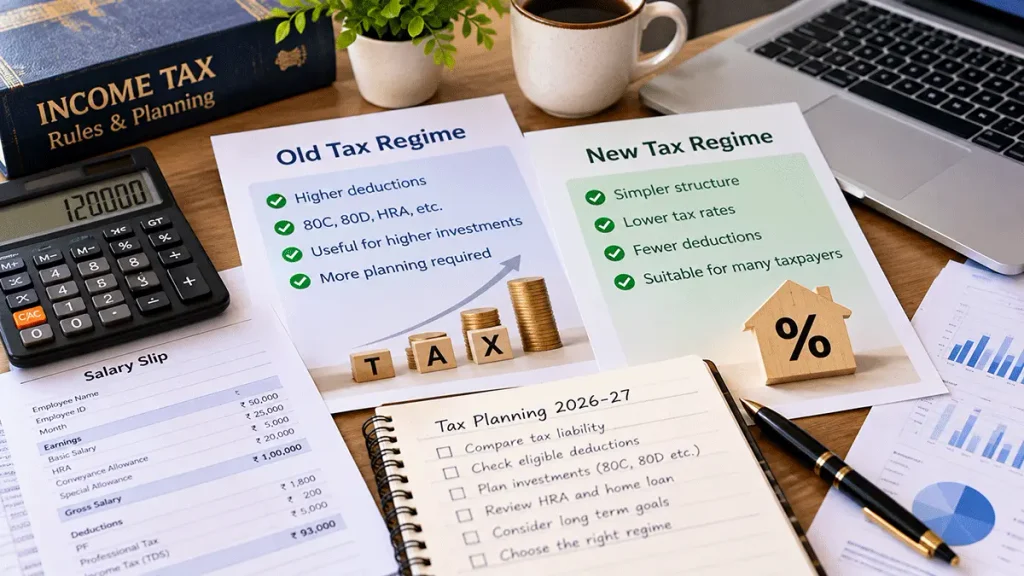
The old tax regime is the traditional income tax structure under which eligible taxpayers can claim various deductions and exemptions. These may include investments under Section 80C, health insurance premiums under Section 80D, House Rent Allowance (HRA) and qualifying home loan interest.
The principal advantage is that eligible expenses and investments can reduce taxable income. However, the old regime generally has higher tax rates than the new regime.
Old Tax Regime Slabs for FY 2026–27
For an individual below 60 years of age:
| Taxable Income | Income Tax Rate |
|---|---|
| Up to ₹2,50,000 | Nil |
| ₹2,50,001–₹5,00,000 | 5% |
| ₹5,00,001–₹10,00,000 | 20% |
| Above ₹10,00,000 | 30% |
These are marginal slab rates. Only the income falling within each slab is taxed at that slab’s rate. Different basic exemption limits apply to qualifying resident senior citizens under the old regime.
What Is the New Tax Regime?
The new tax regime is the default tax regime for eligible taxpayers. It offers wider lower-rate slabs and a simpler structure with fewer available deductions and exemptions. The new regime can be particularly attractive for people who do not have substantial tax-saving deductions.
New Tax Regime Slabs for FY 2026–27
| Taxable Income | Income Tax Rate |
|---|---|
| Up to ₹4,00,000 | Nil |
| ₹4,00,001–₹8,00,000 | 5% |
| ₹8,00,001–₹12,00,000 | 10% |
| ₹12,00,001–₹16,00,000 | 15% |
| ₹16,00,001–₹20,00,000 | 20% |
| ₹20,00,001–₹24,00,000 | 25% |
| Above ₹24,00,000 | 30% |
These rates apply progressively. For example, a person with ₹15 lakh of taxable income does not pay 15% tax on the entire ₹15 lakh.
Instead, the income is divided across the applicable slabs.
Is Income Up to ₹12 Lakh Tax-Free Under the New Regime?
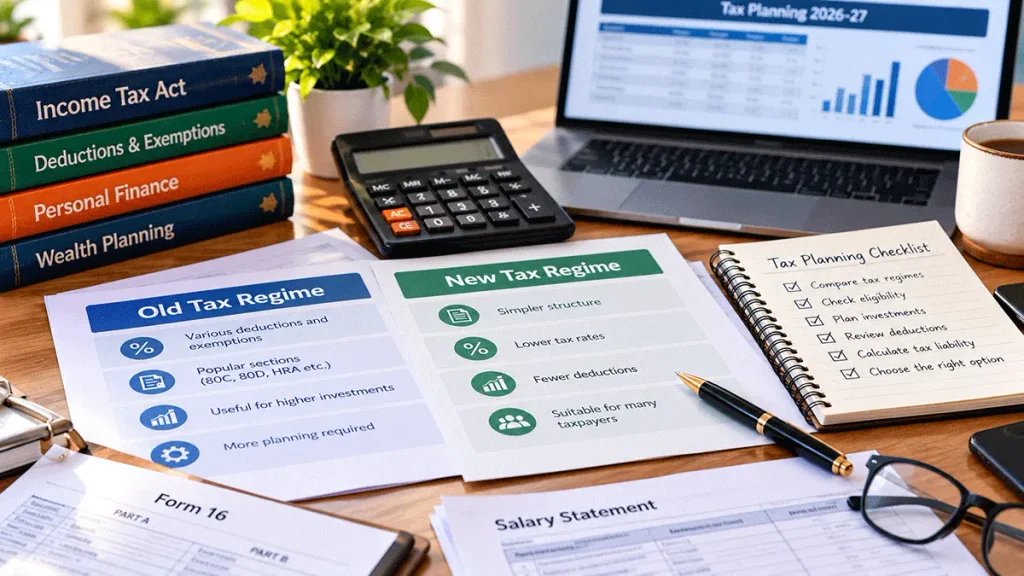
This is one of the most important—and frequently misunderstood—features of the new regime. Under the applicable rebate provisions, an eligible resident individual with total taxable income up to ₹12 lakh can receive a Section 87A rebate of up to ₹60,000 against qualifying slab-rate income tax.
Consider a person with ₹12 lakh of ordinary taxable income.
| Tax Calculation | Amount |
|---|---|
| Tax on first ₹4 lakh | ₹0 |
| Tax on next ₹4 lakh at 5% | ₹20,000 |
| Tax on next ₹4 lakh at 10% | ₹40,000 |
| Tax before rebate | ₹60,000 |
| Eligible Section 87A rebate | ₹60,000 |
| Tax after rebate | ₹0 |
This does not mean the ₹12 lakh is exempt from taxation. Rather, the calculated tax is offset by the applicable rebate.
Important Exceptions
The ₹12 lakh rebate benefit is not available in the same way to everyone.
In particular:
- Section 87A eligibility is restricted to resident individuals.
- Tax on certain special-rate income is not covered by the new-regime rebate.
- Income above ₹12 lakh may attract tax, subject to applicable marginal relief.
- The taxpayer must satisfy the relevant statutory conditions.
Capital gains, lottery winnings and other specially taxed income require separate attention.
Can Salaried Employees Earn ₹12.75 Lakh Without Paying Income Tax?
For eligible salaried taxpayers, the new regime provides a standard deduction of ₹75,000.
This means an individual earning ₹12.75 lakh entirely as eligible salary income may have taxable income of ₹12 lakh after the standard deduction.
| Particulars | Amount |
|---|---|
| Gross eligible salary income | ₹12,75,000 |
| Standard deduction | ₹75,000 |
| Taxable income | ₹12,00,000 |
| Tax before rebate | ₹60,000 |
| Eligible rebate | ₹60,000 |
| Final income tax | ₹0 |
This illustration assumes no other taxable income, no special-rate income and full eligibility for the deduction and rebate.
The ₹12.75 lakh figure is not a universal tax-free income limit. It arises from the interaction of the salaried standard deduction and the rebate. A self-employed person cannot automatically claim the same salaried standard deduction against business income.
Which Deductions Are Available Under the Old Regime?
The old regime may be attractive to taxpayers with substantial eligible deductions.
Section 80C
Eligible investments and payments may qualify for a deduction of up to ₹1.5 lakh in aggregate.
Examples include:
- Eligible Public Provident Fund contributions.
- Qualifying life insurance premiums.
- Eligible ELSS mutual fund investments.
- Certain tuition fees.
- Qualifying home loan principal repayments.
- Other eligible savings instruments.
The ₹1.5 lakh limit generally applies to the combined qualifying amount, not separately to each investment.
Section 80D
Eligible health insurance premiums and certain qualifying medical expenses may provide deductions, subject to statutory conditions and limits.
House Rent Allowance
Eligible salaried employees receiving HRA may claim an exemption calculated under prescribed rules. The exemption depends on salary components, actual rent paid and the applicable city classification. Paying rent does not automatically make the entire rent amount deductible.
Home Loan Interest
Eligible interest on a housing loan may be deductible under the relevant house property provisions, subject to conditions and limits.
Other Deductions
Additional deductions may apply for qualifying NPS contributions, donations and other eligible payments.
Not every deduction is available to every taxpayer.
Are All Deductions Removed Under the New Regime?
No. The new regime restricts many familiar deductions, but certain deductions and exemptions remain available.
Examples include the eligible salaried standard deduction and qualifying employer contributions to NPS under the applicable provisions.
However, common old-regime benefits such as Section 80C, Section 80D and HRA exemption are generally unavailable under the new regime.
The precise treatment depends on the taxpayer’s circumstances and the governing legislation. This is why comparing regimes requires more than simply adding up all investments.
Old vs New Tax Regime: Example With ₹10 Lakh Salary
Consider a salaried individual below 60 years of age earning ₹10 lakh annually. Assume there are no deductions beyond the applicable standard deduction.
Under the New Regime
| Particulars | Amount |
|---|---|
| Gross salary | ₹10,00,000 |
| Standard deduction | ₹75,000 |
| Taxable income | ₹9,25,000 |
| Tax before rebate | ₹32,500 |
| Eligible rebate | ₹32,500 |
| Final tax | ₹0 |
Under the Old Regime
| Particulars | Amount |
|---|---|
| Gross salary | ₹10,00,000 |
| Standard deduction | ₹50,000 |
| Taxable income | ₹9,50,000 |
| Tax before cess | ₹1,02,500 |
| Health and Education Cess at 4% | ₹4,100 |
| Final tax | ₹1,06,600 |
Under these assumptions, the new regime produces a substantially lower tax liability.
But this example does not include any additional old-regime deductions.
Old vs New Tax Regime: Example With ₹15 Lakh Salary
Now consider a salaried individual earning ₹15 lakh annually. Assume the person has no additional eligible deductions beyond the standard deduction.
New Regime Calculation
| Particulars | Amount |
|---|---|
| Gross salary | ₹15,00,000 |
| Standard deduction | ₹75,000 |
| Taxable income | ₹14,25,000 |
| Income tax before cess | ₹93,750 |
| Health and Education Cess at 4% | ₹3,750 |
| Total tax | ₹97,500 |
Old Regime Calculation
| Particulars | Amount |
|---|---|
| Gross salary | ₹15,00,000 |
| Standard deduction | ₹50,000 |
| Taxable income | ₹14,50,000 |
| Income tax before cess | ₹2,47,500 |
| Health and Education Cess at 4% | ₹9,900 |
| Total tax | ₹2,57,400 |
Difference: ₹1,59,900 in favour of the new regime.
This illustrates why the new regime can be highly attractive when additional deductions are limited. However, an individual with substantial eligible HRA, housing loan interest and other deductions may reach a different result.
When Can the Old Tax Regime Be Better?
The old regime may deserve closer examination when you have significant qualifying deductions and exemptions.
Consider someone who:
- Receives eligible HRA and pays substantial rent.
- Has qualifying home loan interest.
- Makes eligible Section 80C investments.
- Pays qualifying health insurance premiums.
- Has other available deductions.
These benefits can reduce taxable income under the old regime. But a deduction does not save tax equal to its full amount.
For example, a ₹1 lakh deduction does not necessarily save ₹1 lakh in tax.
The tax benefit depends on the marginal tax rate and the taxpayer’s overall calculation. Therefore, it is important to compare the final tax liability under both regimes.

Should You Invest Just to Save Income Tax?
Tax planning and financial planning should support each other. An investment that offers a deduction is not automatically suitable for everyone. For example, purchasing a financial product solely to claim a tax benefit may create unnecessary costs or lock-in obligations.
Before making an investment, consider:
- Whether it suits your financial goals.
- The risks involved.
- The investment horizon.
- Liquidity requirements.
- Applicable charges.
- Whether the tax benefit is actually available to you.
A tax deduction should be a benefit of a suitable financial decision—not the only reason for making it.
What About Senior Citizens?
The old tax regime provides higher basic exemption thresholds for qualifying resident senior citizens.
Generally, under the old regime:
| Category | Basic Exemption |
|---|---|
| Individual below 60 | ₹2.5 lakh |
| Resident senior citizen aged 60 to below 80 | ₹3 lakh |
| Resident super senior citizen aged 80 or above | ₹5 lakh |
Under the new regime, the ₹4 lakh basic exemption slab applies without the same age-based distinction. However, the higher old-regime basic exemption does not automatically make the old regime more beneficial.
Senior citizens should compare both calculations, considering pension income, interest income, deductions and other applicable rules.
Can You Switch Between the Old and New Tax Regimes?
The switching rules depend partly on whether you have business or professional income.
Salaried Taxpayers Without Business Income
Eligible taxpayers without business or professional income can generally choose the applicable regime when filing their income tax return each year, subject to the relevant requirements.
Taxpayers With Business or Professional Income
The rules are more restrictive. Choosing to opt out of the default new regime may involve prescribed declarations and limits on subsequently changing the choice.
For tax year 2026–27, taxpayers should follow the applicable provisions and prescribed forms under the Income-tax Act, 2025. Business owners, freelancers and professionals should confirm the procedural requirements before filing.
How to Choose the Right Tax Regime
A practical comparison involves five steps.
Step 1: Calculate Your Total Income
Include all relevant income sources, such as salary, eligible business income, bank interest and other taxable receipts. Treat specially taxed income separately where required.
Step 2: Identify Eligible Deductions
List only deductions and exemptions that you actually qualify for. Do not include an investment simply because it is commonly advertised as tax-saving.
Step 3: Calculate Tax Under the Old Regime
Apply the relevant deductions, exemptions, slab rates, rebate eligibility and cess.
Step 4: Calculate Tax Under the New Regime
Apply the permitted deductions, new-regime slabs, applicable rebate, marginal relief where relevant and cess.
Step 5: Compare Final Tax Payable
Choose the regime that produces the more favourable outcome while complying with the applicable eligibility and procedural requirements. Do not base the decision solely on the tax deducted by your employer during the year.
Common Mistakes to Avoid
Assuming Everyone Pays Zero Tax Up to ₹12 Lakh
The rebate has eligibility conditions and does not apply to all types of income.
Confusing Gross Salary With Taxable Income
Salary income may be reduced by the applicable standard deduction before calculating taxable income.
Assuming the New Regime Has No Deductions
Certain deductions remain available.
Comparing Only Tax Slab Rates
The final result also depends on exemptions, deductions, rebates and other rules.
Ignoring Special-Rate Income
Certain capital gains and other income categories may be taxed under separate provisions.
Forgetting Business Income Restrictions
Taxpayers with business or professional income may face additional conditions when switching regimes.
The MoneyTrendy Takeaway
For FY 2026–27, the new tax regime offers attractive slab rates and a significant rebate for eligible resident individuals.
For many salaried taxpayers with limited deductions, it may result in a lower tax bill. The old regime, however, remains relevant for individuals who can claim substantial qualifying exemptions and deductions. There is no need to choose based on advertisements or assumptions.
Calculate your tax liability under both regimes using your actual income and eligible deductions.
The better regime is the one that legally produces the more suitable outcome for your circumstances.
Frequently Asked Questions
Is the New Tax Regime Mandatory in FY 2026–27?
No. It is the default regime, but eligible taxpayers may opt for the old regime according to applicable rules and procedures.
Is ₹12 Lakh Income Completely Tax-Free?
Eligible resident individuals with up to ₹12 lakh of ordinary taxable income may receive a rebate that eliminates qualifying slab-rate income tax. Special-rate income and other eligibility conditions can change the outcome.
Is ₹12.75 Lakh Salary Tax-Free?
An eligible salaried individual earning ₹12.75 lakh entirely as qualifying salary may have ₹12 lakh taxable income after the ₹75,000 standard deduction. If all rebate conditions are satisfied and there is no other relevant income, the resulting slab-rate tax can be zero.
Can I Claim Section 80C Under the New Tax Regime?
Generally, no. Section 80C deductions are ordinarily associated with the old regime.
Which Regime Is Better for a Home Loan Borrower?
It depends on the eligibility and amount of the home loan deduction, other deductions, income and final tax calculation. Having a home loan does not automatically make the old regime better.
Can Freelancers Choose the Old Tax Regime?
Eligible freelancers and professionals may have an option to choose the old regime, but business or professional income can trigger additional procedural and switching restrictions.
Sources & References
This article is based on official Income Tax Department and Ministry of Finance publications.
- Income Tax Department — Budget 2026 FAQs — Tax rates and legislative changes applicable from tax year 2026–27.
- Income Tax Department — Tax Rates and Computation — Slab rates, rebates, deductions and regime selection.
- Income Tax Department — Old vs New Tax Regime Guide — Official explanatory comparison.
- Income Tax e-Filing Portal — Taxpayer guidance, forms and return filing information.
Tax provisions and interpretations can change. Check the applicable legislation, official notifications and latest departmental guidance before filing.
Disclaimer: This article is for general educational purposes and does not constitute personalised tax, legal or financial advice. Individual tax liabilities depend on income composition, residency, eligibility, deductions and other circumstances. Consult a qualified tax professional where appropriate.
Editorial & financial note
MoneyTrendy content is educational and does not constitute personalised financial, investment, tax or legal advice.