Read the full context, compare alternatives and consider your own circumstances before making a financial decision.
A new laptop costs ₹60,000. Your washing machine suddenly stops working. Or an unexpected family expense arrives when your savings are already stretched. You need money, but paying the entire amount immediately could put pressure on your monthly budget.
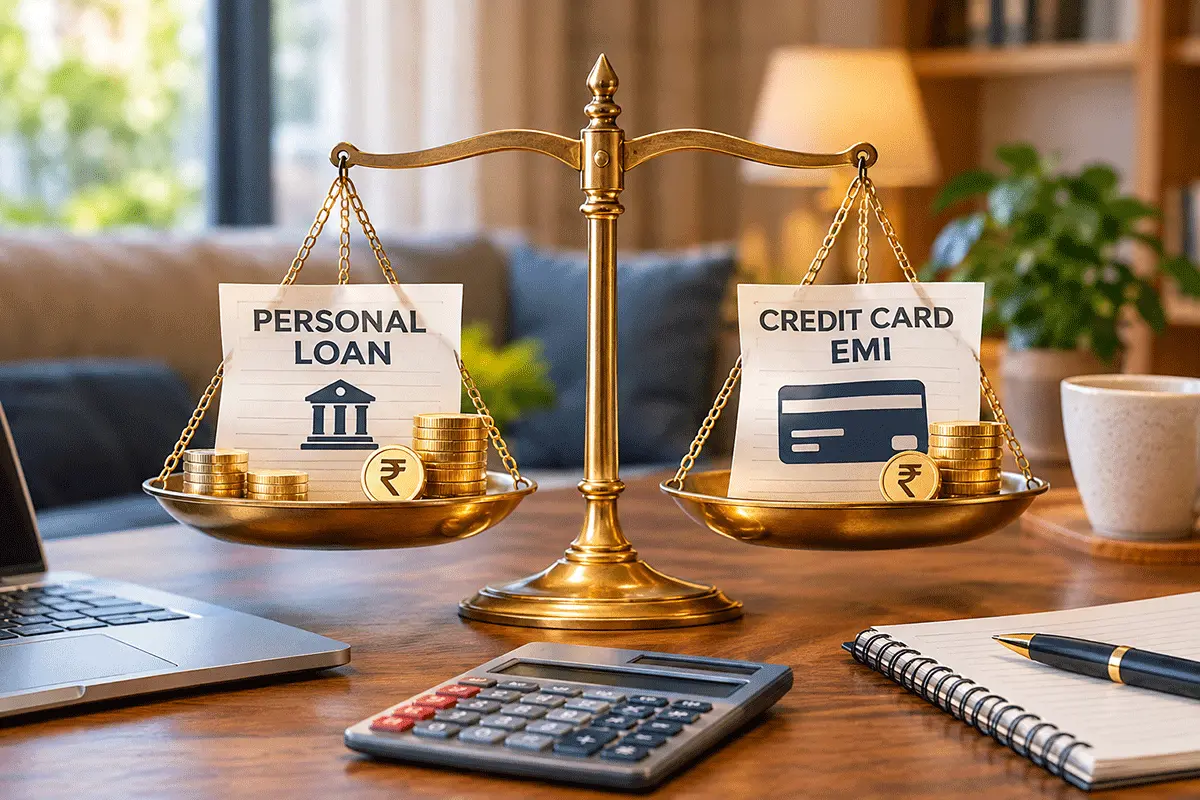
Two familiar options may come to mind: taking a personal loan or converting a credit card purchase into EMIs.
Both allow you to spread repayment over several months. Both can involve interest and additional charges. And both can become expensive if you don’t understand the actual cost. But which one is cheaper? The answer isn’t as simple as comparing two advertised interest rates.
A personal loan charging 12% annually may cost less than a credit card EMI charging 16%. Yet a short-duration, genuinely low-cost card offer could be more economical than a personal loan with substantial processing fees.
The real question is: How much will you repay in total, and what conditions come with that repayment?
Personal Loan vs Credit Card EMI at a Glance
| Feature | Personal Loan | Credit Card EMI |
|---|---|---|
| Main purpose | Borrow funds for eligible personal expenses | Repay an eligible card purchase or balance in instalments |
| Approval | Usually requires a loan assessment | Often offered to eligible cardholders |
| Amount available | Depends on lender approval | Depends on card limit and issuer rules |
| Interest | Based on the loan offer | Based on the EMI offer |
| Processing fee | May apply | May apply |
| Repayment period | Often offers longer tenures | Often offers shorter tenures |
| Early closure | May involve charges | May involve foreclosure charges |
| Best comparison measure | Total repayment and APR | Total repayment, effective costs and offer terms |
Neither option is automatically cheaper. The better choice depends on the actual offers available to you.

What Is a Personal Loan?
A personal loan is generally an unsecured loan offered by a bank or another eligible lender. Unlike a home loan or vehicle loan, it typically doesn’t require you to pledge the asset being purchased as collateral. The lender evaluates factors such as your income, existing financial obligations, repayment history and credit profile before deciding whether to approve the application.
Suppose a bank approves a personal loan of ₹1,00,000 for 24 months. You receive the loan proceeds, subject to any applicable deductions, and repay the amount through scheduled EMIs. Each EMI normally includes a portion of the principal and interest. However, the amount credited to your bank account may be lower than the sanctioned loan amount if the lender deducts processing fees or other permitted charges upfront. That distinction matters when calculating the actual cost of borrowing.
What Is Credit Card EMI?
A credit card EMI facility allows an eligible transaction or outstanding amount to be repaid in instalments under terms offered by the card issuer.
For example, you purchase a refrigerator worth ₹45,000 using your credit card.
Instead of paying the entire purchase amount in the next billing cycle, you may be offered an option to repay it over six, nine or twelve months. The EMI may include interest, and the issuer may charge a processing fee or other applicable charges.
Some offers are advertised as no-cost EMI. But no-cost EMI doesn’t necessarily mean there are no associated expenses. There may be processing fees, applicable taxes or a merchant discount adjustment. You also need to check whether selecting EMI means giving up an instant discount available through another payment method.
The Reserve Bank of India’s credit card directions require issuers to disclose important EMI conversion details, including principal, interest and applicable upfront discounts. Interest-bearing EMI offers must not be misleadingly presented as no-cost offers.
How Is Personal Loan EMI Calculated?
For a standard reducing-balance personal loan with fixed monthly repayments, the EMI depends on three factors:
- Principal (P): The amount borrowed.
- Monthly interest rate (r): The annual interest rate divided by 12 and then by 100.
- Tenure (n): The number of monthly instalments.
The standard EMI formula is:
EMI = [P × r × (1 + r)^n] ÷ [(1 + r)^n − 1]
Example: ₹60,000 Personal Loan at 12% Interest
Suppose you borrow ₹60,000 at an annual reducing-balance interest rate of 12% for 12 months.
| Particulars | Amount |
|---|---|
| Loan amount | ₹60,000 |
| Annual interest rate | 12% |
| Repayment tenure | 12 months |
| Monthly EMI | ₹5,331 approximately |
| Total interest | ₹3,971 approximately |
| Total repayment | ₹63,971 approximately |
Illustrative calculation based on monthly reducing-balance interest. Processing fees, GST and other charges are excluded.
The interest is not calculated simply by multiplying ₹60,000 by 12%. That’s because the outstanding principal gradually reduces as you repay the loan. This is why understanding the interest calculation method is important.
Personal Loan vs Credit Card EMI: A ₹60,000 Comparison
Let’s compare two hypothetical borrowing offers for the same ₹60,000 expense over 12 months.
For this example, we assume:
- Personal loan: 12% annual reducing-balance interest with a ₹1,000 processing fee.
- Credit card EMI: 16% annual reducing-balance interest with a ₹500 processing fee.
Both calculations assume equal monthly instalments.
Which Option Costs Less?
| Particulars | Personal Loan | Credit Card EMI |
|---|---|---|
| Principal | ₹60,000 | ₹60,000 |
| Annual interest rate | 12% | 16% |
| Tenure | 12 months | 12 months |
| Approximate monthly EMI | ₹5,331 | ₹5,444 |
| Approximate total interest | ₹3,971 | ₹5,326 |
| Processing fee | ₹1,000 | ₹500 |
| Total repayment including fee | ₹64,971 | ₹65,826 |
Figures are rounded and illustrative. GST, lost discounts and other possible charges are excluded. Actual card EMI calculation methods and terms may differ.
In this example, the personal loan costs approximately ₹855 less than the credit card EMI. However, this doesn’t mean personal loans are always cheaper. A different interest rate, processing fee or promotional offer could change the result.
The lesson: Never compare borrowing options based only on their monthly EMIs. Compare the complete repayment cost.
Calculate Your Own EMI
Before accepting a loan, use the MoneyTrendy EMI Calculator to estimate your monthly instalment and total interest. Remember that calculator results are estimates, not final lender quotations.

Why the Interest Rate Alone Can Be Misleading
Imagine two lenders advertise a 12% interest rate. One calculates interest on a reducing balance. Another uses a flat-rate method. Although both advertisements mention 12%, the actual borrowing costs can be substantially different. With reducing-balance interest, interest is calculated on the outstanding principal. With flat-rate interest, interest is generally calculated on the original principal throughout the stated period.
For example, ₹60,000 borrowed for one year at a 12% flat rate produces ₹7,200 in stated interest before other charges. That is different from the approximately ₹3,971 of interest in our 12% reducing-balance illustration. Therefore, ask the lender for the effective annual borrowing cost, not just the advertised rate.
What Is APR and Why Does It Matter?
APR stands for Annual Percentage Rate. It is designed to express the annualised cost of credit, taking relevant charges into account. For applicable retail term loans, the RBI’s Key Facts Statement framework requires lenders to disclose APR and other important borrowing terms.
The framework also requires an amortisation schedule and disclosure of relevant fees, helping borrowers compare loan offers more meaningfully. However, don’t assume every credit card EMI conversion is governed by exactly the same KFS requirements as a separate personal loan. Credit card transactions and card-linked loans can fall under different applicable rules.
For a card EMI, request the full repayment schedule and all charges directly from the issuer.
Charges You Should Check Before Borrowing
The actual cost of borrowing can extend beyond the advertised interest.
Processing Fees
A lender may charge a one-time fee for setting up the loan or converting a purchase into EMIs. Even a small fee can make a significant difference on a short-tenure loan.
GST on Applicable Fees and Charges
Taxes can apply to processing fees and certain other charges. Confirm the tax-inclusive amounts in your offer.
Foreclosure or Prepayment Charges
If you repay the borrowing early, some arrangements may involve charges, depending on the product, lender, interest-rate structure and applicable regulations. Never assume early repayment is free without checking the agreement.
Late Payment Charges
Missing an EMI can lead to additional costs and may affect your credit history.
Lost Merchant Discounts
A card EMI offer may prevent you from receiving a discount that would otherwise be available for paying in full. A ₹1,500 lost discount is a real economic cost, even if it doesn’t appear as interest.
Is No-Cost EMI Really Free?
Suppose a laptop is advertised at ₹50,000 with a six-month no-cost EMI. The seller or card issuer may structure the offer so that an upfront discount offsets the interest component. That can make the scheduled instalments add up to the advertised purchase price. But you should still check whether there is a processing fee, applicable GST or a better price for another payment method.
For example:
| Item | Illustrative Amount |
|---|---|
| Advertised product price | ₹50,000 |
| Total scheduled EMIs | ₹50,000 |
| Processing fee | ₹499 |
| GST on fee at assumed 18% | ₹89.82 |
| Total cash outflow | ₹50,588.82 |
In this example, the offer is not completely free of additional costs.
The actual terms of no-cost EMI offers vary, so always read the checkout disclosure and card issuer’s confirmation before accepting.

Which Option Is Better for a Large Expense?
A personal loan may be more practical when you need funds for several expenses rather than a single card purchase. It may also offer a longer repayment period. But longer tenure has a trade-off. Your monthly EMI may fall, while your total interest expense rises.
For example, spreading a ₹1 lakh loan over three years rather than one year can reduce the monthly instalment, but it usually increases the total interest paid if the annual rate remains unchanged.
A credit card EMI may be more convenient for an eligible purchase, particularly when a transparent promotional offer produces a genuinely lower overall cost. The right choice depends on your actual quotation, not the product label.
How Does Borrowing Affect Your Credit Score?
Both personal loans and credit card obligations can influence your credit profile. Lenders may report repayment information to credit information companies. Consistent on-time repayment can support a positive credit history, while missed payments can damage it. A personal loan application may involve a credit enquiry.
Credit card EMI arrangements may also affect your available credit limit, depending on the issuer’s rules. Before borrowing, consider the effect on your existing monthly commitments. Taking a new loan simply because you qualify for one isn’t necessarily a sound financial decision.
Five Questions to Ask Before Choosing
Rather than immediately selecting the lowest displayed EMI, answer these five questions.
- How much will I repay in total? Include interest, processing fees, taxes and any lost discounts.
- Can I comfortably afford the monthly EMI? Account for existing loans, household expenses and essential savings.
- What happens if I repay early? Check applicable foreclosure or prepayment conditions.
- What happens if I miss a payment? Understand late charges and potential credit-history consequences.
- Do I need to borrow at all? Consider whether the purchase can safely be postponed or funded without expensive debt.
The fifth question may be the most valuable. Not every available credit facility needs to be used.
When Should You Avoid Both Options?
Borrowing deserves particular caution when your income is uncertain, your existing EMIs are already difficult to manage, or the purchase is mainly discretionary.
Using a new loan to manage repayments on older debt can also become risky without a realistic debt-repayment plan. For some expenses, waiting and saving may be financially healthier than paying additional borrowing costs.
An emergency fund can reduce the need to borrow for unexpected household expenses. And for planned purchases, regularly setting aside money in an appropriate savings product may avoid interest costs entirely.
The MoneyTrendy Takeaway
A personal loan isn’t always cheaper than a credit card EMI. A credit card EMI isn’t automatically more convenient or more expensive. And a no-cost EMI isn’t necessarily free of every charge.
The smarter approach is to compare total repayment, effective borrowing cost, monthly affordability and contractual conditions.
Choose the borrowing option that fits your actual financial situation—not the one with the most attractive advertisement. Sometimes, the most economical option is not borrowing at all.
Frequently Asked Questions
Is a Personal Loan Cheaper Than Credit Card EMI?
Not always. A personal loan may offer a lower interest rate, but fees and repayment tenure also affect the total cost. Compare actual quotations.
Is Credit Card EMI Better for Short-Term Purchases?
It can be convenient for eligible purchases, especially where the complete offer has low fees and a competitive total repayment amount. Convenience alone doesn’t make it cheaper.
Can I Convert Every Credit Card Purchase Into EMI?
No. Eligibility depends on the card issuer, transaction, amount and available offers.
Does No-Cost EMI Affect My Credit Score?
A no-cost EMI is still a credit obligation. Missed repayments can affect your credit history, depending on how the issuer reports the account.
Can I Close a Personal Loan Before Its Scheduled End?
Often yes, subject to the loan terms and applicable regulatory requirements. Check the lender’s prepayment and foreclosure conditions.
Sources & References
This article draws on regulatory information and consumer guidance published by the Reserve Bank of India (RBI).
- Reserve Bank of India — Official banking regulations and consumer information.
- RBI — Credit Card and Debit Card Directions (2022), amended in March 2024 — Rules governing credit card practices, including EMI disclosures.
- RBI — Key Facts Statement for Loans & Advances (April 2024) — Guidance on disclosure of borrowing costs and loan terms.
Sources are provided for verification. Lending terms, regulations and applicable charges may change. Readers should consult the latest official documents and their lender’s current terms before making borrowing decisions.
Financial Disclaimer: This article is intended for general educational and informational purposes only. It does not constitute personalised financial, legal or tax advice. Interest rates, fees, eligibility criteria and repayment conditions vary by lender and may change. Always review the relevant loan documents and consider your financial circumstances before borrowing.
Editorial & financial note
MoneyTrendy content is educational and does not constitute personalised financial, investment, tax or legal advice.