

Read the full context, compare alternatives and consider your own circumstances before making a financial decision.
You switch on the television in the morning and hear a familiar headline:
“The Sensex gained 500 points today, while the Nifty 50 closed 150 points higher.”
Financial news channels repeat these numbers throughout the trading day. Newspapers display them prominently, and investment apps show them alongside stock prices. But what do these numbers actually mean?
If the Sensex rises, does that mean every company in India is performing well? Is the Nifty 50 a better measure of the stock market? And why do the two indices have such different numerical values?
For someone beginning their investment journey, these questions are perfectly reasonable.
The Sensex and Nifty 50 are two of India’s most widely followed stock market indices. Both help investors understand the performance of major listed companies, but they are not identical.
Let’s understand how they work, what makes them different and how beginners can use them to follow the Indian stock market.

What Is a Stock Market Index?
Before comparing Sensex and Nifty, it helps to understand what a stock market index actually represents. Imagine you want to understand how the Indian stock market performed today. Thousands of securities trade on Indian stock exchanges. Checking every stock individually would be impractical.
A stock market index solves this problem by tracking a selected group of securities according to defined rules. It combines their price movements into a single numerical measure. For example, if an index rises by 1% during a trading session, it indicates that the weighted value of its constituent stocks has increased by approximately 1%.
However, this does not mean every stock in the index gained 1%. Some companies may rise sharply, others may fall, and some may remain almost unchanged. The overall index reflects their combined weighted performance.
Think of an index as a market indicator—not a complete picture of every listed company.
What Is the Sensex?
The Sensex is the benchmark index associated with the Bombay Stock Exchange (BSE).
Its official name is the BSE SENSEX.
It tracks 30 major companies selected according to the index provider’s eligibility and selection rules. These companies represent important segments of the Indian economy. The Sensex is one of India’s oldest and most recognised equity market benchmarks.
What Does Sensex Mean?
The name Sensex comes from the expression “Sensitive Index.” It is commonly used as an indicator of the performance of major companies listed on the BSE. When financial news reports that the Sensex has risen or fallen, it is referring to a change in the index level.
How Many Companies Are in the Sensex?
The Sensex represents 30 companies. The composition is reviewed periodically, and companies can be added or removed according to the applicable index methodology. Therefore, the list of constituent companies is not permanently fixed.
How Is Sensex Calculated?
The Sensex uses a float-adjusted market capitalisation weighting methodology. In simple terms, companies with a higher eligible market value generally have a greater influence on index movements. We will explain this calculation later in the article.
What Is the Nifty 50?
The Nifty 50 is a benchmark equity index associated with the National Stock Exchange of India (NSE). It represents 50 major companies selected under the methodology maintained by NSE Indices Limited.
Like the Sensex, the Nifty 50 tracks companies from important sectors of the Indian economy. The Nifty 50 is widely used by investors, fund managers and market analysts.
It also serves as an underlying benchmark for various financial products, including index funds, exchange-traded funds and derivatives.
What Does Nifty Mean?
The name Nifty combines the words “National” and “Fifty.” The number 50 refers to the companies represented by the index.
How Many Companies Are in the Nifty 50?
The Nifty 50 represents 50 companies. These companies are selected using criteria that include market capitalisation, liquidity and other eligibility requirements. Its constituents are reviewed periodically.
How Is Nifty 50 Calculated?
The Nifty 50 uses a free-float market capitalisation weighted methodology. This means the influence of each company depends on its eligible market capitalisation rather than every company receiving equal weight.
Sensex vs Nifty 50: Main Differences
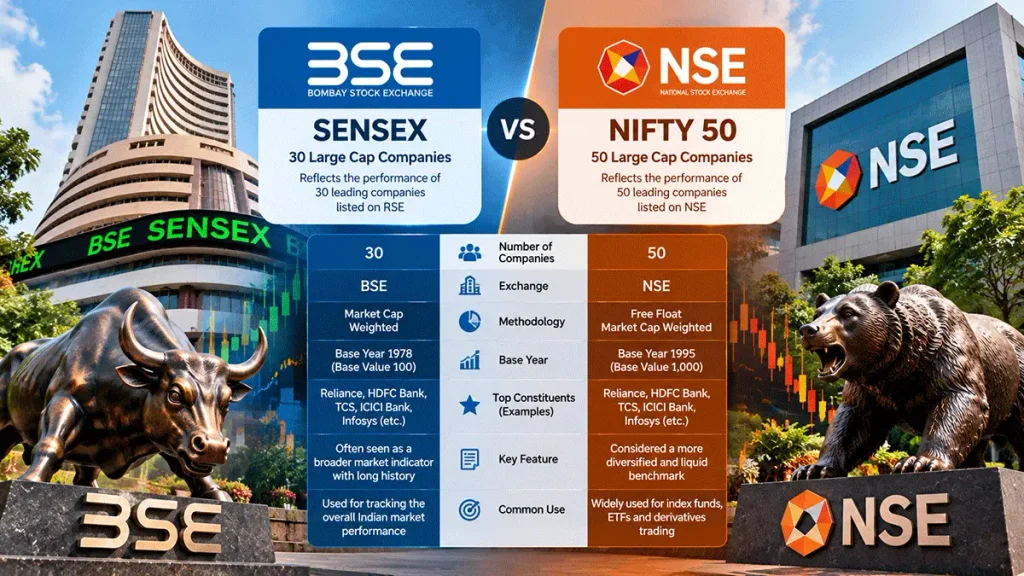
The following table summarises the most important distinctions.
| Feature | Sensex | Nifty 50 |
|---|---|---|
| Associated exchange | BSE | NSE |
| Number of companies | 30 | 50 |
| Index provider | BSE Index Services | NSE Indices Limited |
| Base period | 1978–79 | 3 November 1995 |
| Base index value | 100 | 1,000 |
| Weighting method | Float-adjusted market capitalisation | Free-float market capitalisation |
| Market representation | Selected major BSE companies | Selected major NSE companies |
| Investment products | Index funds, ETFs and derivatives | Index funds, ETFs and derivatives |
| Main purpose | Benchmark for major Indian equities | Benchmark for major Indian equities |
Both indices are designed to reflect the performance of prominent listed companies. The main differences lie in their constituent counts, index construction rules, histories and associated exchanges.
Why Does Sensex Have 30 Companies While Nifty Has 50?
The Sensex and Nifty 50 were developed independently, with different index histories and methodologies. The Sensex represents 30 selected companies.
The Nifty 50 represents 50 selected companies. Because the Nifty 50 includes more companies, it may provide somewhat broader representation within the large-company segment.
However, having more companies does not automatically mean an index is more diversified in every respect.
The actual level of diversification also depends on sector exposure and how much weight is concentrated in the largest companies. For example, if a few large financial companies account for a substantial share of an index, their performance can significantly influence its movement. This is true even when the index contains many other companies.
What Is Free-Float Market Capitalisation?
This is one of the most important concepts for understanding both indices.
First, Understand Market Capitalisation
Market capitalisation is the total market value of a company’s outstanding equity shares.
The basic formula is:
Market Capitalisation = Share Price × Total Outstanding Shares
Suppose a company has 10 crore outstanding shares.
If each share trades at ₹200:
Market Capitalisation = 10 crore × ₹200 = ₹2,000 crore
This is the company’s full market capitalisation.
What Does Free Float Mean?
Not every outstanding share is necessarily available for regular public trading. Some shares may be held by promoters or other strategic shareholders. Free-float market capitalisation focuses on the portion of shares considered available for investment under the index provider’s rules.
A Simple Example
Imagine a hypothetical company with the following details:
| Particulars | Value |
|---|---|
| Total outstanding shares | 10 crore |
| Market price per share | ₹200 |
| Full market capitalisation | ₹2,000 crore |
| Eligible free-float proportion | 40% |
| Free-float market capitalisation | ₹800 crore |
In this example, the index would use the eligible free-float market value rather than the full ₹2,000 crore. Actual calculations involve the index provider’s investible weight factors and other methodological adjustments.
Why Does This Matter?
A larger company with a higher free-float market capitalisation generally carries more weight in a free-float weighted index. Consequently, its share price movement can influence the index more than that of a smaller constituent. This is why an index may rise even when many of its individual stocks decline.
Why Do Sensex and Nifty Have Different Values?
You may notice that the Sensex is quoted at a much higher numerical level than the Nifty 50. Does that mean the Sensex is more valuable or has performed better?
No.
The numerical levels of two different indices cannot be compared directly.
Each index has its own base period, base value and calculation history. The Sensex uses a base value of 100 for its historical base period. The Nifty 50 uses a base value of 1,000 for its base date. Their index levels have evolved from different starting points.
Compare Percentage Changes, Not Points
Suppose the following hypothetical market movements occur:
| Index | Previous Close | Current Close | Change |
|---|---|---|---|
| Sensex | 80,000 | 80,800 | +1.00% |
| Nifty 50 | 24,000 | 24,240 | +1.00% |
The Sensex gained 800 points. The Nifty gained 240 points. But both rose by exactly 1%. This illustrates why percentage changes are generally more meaningful than absolute point changes when comparing different indices.
Do Sensex and Nifty Always Move Together?
The Sensex and Nifty 50 often move in the same general direction because they track major companies operating within the same economy. Many prominent companies may be represented in both indices. However, their movements are not always identical.
The differences arise from factors such as:
- Different numbers of constituent companies.
- Different company weightings.
- Changes in index composition.
- Sector representation.
- Company-specific price movements.
For example, strong performance by a heavily weighted company may have a different impact on the Sensex than on the Nifty 50.
Therefore, the two indices can produce slightly different percentage returns over the same period.
Can Sensex or Nifty Rise While Most Stocks Fall?
Yes. This can happen because both indices use market capitalisation-based weighting. Imagine an index containing several large companies.
A few heavily weighted companies rise strongly, while many smaller-weighted constituents decline. The gains from the larger companies may outweigh the losses elsewhere. As a result, the overall index can finish higher even when more constituents fall than rise.
This is one reason experienced investors also examine market breadth.
Market breadth measures how widely gains or losses are distributed across the market. Indicators such as advancing and declining stocks can provide additional context.
Does a Rising Sensex Mean the Indian Economy Is Doing Well?
A rising stock market may reflect optimism about future business earnings, economic growth or financial conditions. But stock market performance and economic performance are not identical.
Share prices are influenced by many factors, including:
- Corporate earnings expectations.
- Interest rates.
- Inflation.
- Global economic developments.
- Foreign and domestic investment flows.
- Currency movements.
- Investor sentiment.
Markets often respond to expectations about the future rather than only current economic conditions. A strong stock market does not necessarily mean every household or business is experiencing the same improvement. Similarly, a market decline does not automatically indicate that the entire economy is contracting.

Which Is Better for Beginners: Sensex or Nifty 50?
For learning about the Indian stock market, both indices are useful. The Sensex provides a familiar benchmark of 30 major companies. The Nifty 50 provides exposure to a selected group of 50 major companies.
A beginner does not need to choose only one index to follow. Monitoring both can help develop an understanding of broader market trends. However, neither index captures the performance of every listed Indian company.
Mid-cap and small-cap stocks can behave very differently from large-cap benchmarks. For a wider view, investors can also study broader market indices.
What About Nifty 500?
The Nifty 500 covers a much larger group of listed companies than the Nifty 50. It provides broader representation across different market-capitalisation segments. This does not make it automatically safer or better for every investor. It simply measures a different and broader market universe.
Can You Invest Directly in Sensex or Nifty 50?
You cannot purchase an index number itself as though it were an individual company share. However, investors can gain exposure to an index through investment products designed to track it. Two common examples are index mutual funds and exchange-traded funds.
Index Mutual Funds
An index mutual fund generally aims to replicate the performance of a specified index, subject to expenses and tracking differences. For example, a Nifty 50 index fund attempts to provide investment exposure aligned with the Nifty 50.
Exchange-Traded Funds
An ETF is an investment fund whose units can be bought and sold on a stock exchange. An ETF tracking the Sensex or Nifty 50 aims to follow the relevant index, subject to its methodology, costs and tracking performance.
Important Risks
Index investing does not eliminate market risk. If the underlying index falls, an index fund or ETF tracking it may also decline. Investors should evaluate expense ratios, tracking differences, liquidity, investment objectives and personal risk tolerance. An index fund is not a guaranteed-return product.
What Is the Difference Between Price Return and Total Return?
When reading about index performance, beginners may encounter two related terms.
Price Return Index
A price return index primarily reflects changes in constituent share prices, adjusted according to the index methodology.
Total Return Index
A total return index also incorporates dividends from constituent companies, based on the index provider’s calculation assumptions.
For long-term investment comparisons, total return data can provide a more complete picture of historical index performance. This distinction is particularly important when comparing mutual fund returns against benchmarks. Always check whether the figures being compared use the same return basis.
What Makes Sensex and Nifty Move Up or Down?
Although each index has its own constituent companies, several common forces influence both.
Corporate Earnings
Strong earnings or improved business expectations can support share prices. Disappointing results can have the opposite effect.
Interest Rates
Changes in interest rates can affect borrowing costs, business valuations and investor preferences.
Inflation
Inflation can influence company costs, consumer demand and monetary policy expectations.
Global Markets
Developments in major international economies can affect Indian market sentiment.
Foreign and Domestic Investment
Buying and selling activity by institutional investors can influence market prices.
Major Economic Announcements
Government policy, the Union Budget and regulatory developments can affect expectations for different sectors.
These factors often interact, making short-term market movements difficult to predict consistently.
Five Common Mistakes Beginners Make
1. Comparing Index Points Instead of Percentages
An 800-point Sensex rise is not automatically stronger than a 200-point Nifty rise. Always examine the percentage change.
2. Assuming Every Stock Moves With the Index
Individual stocks can perform very differently from the benchmark.
3. Believing a Higher Index Level Means a Better Investment
Index levels reflect different historical bases and cannot be used as direct valuation comparisons.
4. Treating Daily Market Movements as Investment Advice
A rising market does not automatically make every stock attractive. A falling market does not necessarily mean every investment should be sold.
5. Ignoring Investment Costs and Risks
Even passive investment products involve expenses, tracking differences and market volatility.
How Beginners Can Follow the Indian Stock Market
You don’t need to monitor stock prices every minute to understand the market. A more useful approach is to build basic financial literacy. Start by following the daily percentage changes in the Sensex and Nifty 50.
Then examine the sectors contributing to those movements. Over time, learn how company earnings, interest rates and broader economic developments influence share prices. If you are considering investing, understand the risks and investment horizon before selecting a product.
For beginners interested in systematic mutual fund investing, our MoneyTrendy guide on What Is SIP and How Does It Work? explains how regular investments operate. Remember that a SIP is an investment method, not a guarantee of returns.
The MoneyTrendy Takeaway
The Sensex and Nifty 50 are two important indicators of India’s equity market. The Sensex tracks 30 selected major companies associated with the BSE. The Nifty 50 tracks 50 selected major companies associated with the NSE.
Both use float-adjusted market capitalisation weighting, so larger eligible companies generally have greater influence over index movements.
Neither index is automatically superior.
For beginners, understanding what these indices measure is more valuable than trying to predict their next daily movement.
Follow percentage changes, learn about market breadth and remember that an index is a benchmark—not a guarantee of investment performance.
Frequently Asked Questions
What Is the Main Difference Between Sensex and Nifty 50?
The Sensex tracks 30 selected major companies associated with the BSE, while the Nifty 50 tracks 50 selected major companies associated with the NSE. They also have different base values and index methodologies.
Is Nifty 50 Better Than Sensex?
Neither is universally better. Both are useful large-cap market benchmarks. The choice depends on whether you are following market trends or evaluating a particular investment product.
Why Is Sensex Higher Than Nifty?
Their numerical levels differ because they have different base periods, base values and calculation histories. A higher numerical level does not establish better performance.
Can I Invest ₹500 in Nifty 50?
Some mutual funds tracking the Nifty 50 may permit relatively small investments, depending on the scheme’s minimum investment requirements. Check the latest scheme documents before investing.
Are Sensex and Nifty 50 Risk-Free?
No. Both represent equity market performance, and investments tracking them are exposed to market risk.
Does Nifty 50 Include Only the 50 Biggest Indian Companies?
Not simply the 50 biggest by total market capitalisation. Selection follows NSE Indices’ methodology, which includes free-float market capitalisation, liquidity and other eligibility criteria.
Sources & References
This article is based on official stock exchange and index provider information.
- National Stock Exchange of India — Nifty 50 Index — Official overview of the Nifty 50 and its role as a benchmark.
- NSE Indices — Nifty 50 — Index history, methodology and constituent information.
- BSE — Equity Indices Methodology — Methodology covering the BSE Sensex and other BSE indices.
- NSE — Index FAQs — Explanations of index construction and index-related concepts.
- NSE Indices — Investible Weight Factors — Explanation of free-float market capitalisation and index weighting.
Index constituents, weightings and methodologies can change. Refer to the official index providers for the latest information.
Financial Disclaimer: This article is intended for educational and informational purposes only. It does not constitute investment advice or a recommendation to buy or sell securities. Equity investments are subject to market risk. Evaluate your financial circumstances and consult an appropriately qualified professional before making investment decisions.
Editorial & financial note
MoneyTrendy content is educational and does not constitute personalised financial, investment, tax or legal advice.