Read the full context, compare alternatives and consider your own circumstances before making a financial decision.
Getting a loan in India no longer always requires visiting a bank branch, submitting physical documents or waiting several days for approval. Today, many digital lending platforms allow people to apply for credit using a smartphone, complete identity verification online and receive funds directly into their bank accounts.
For someone facing an urgent medical expense, delayed salary or unexpected household bill, this convenience can be appealing.
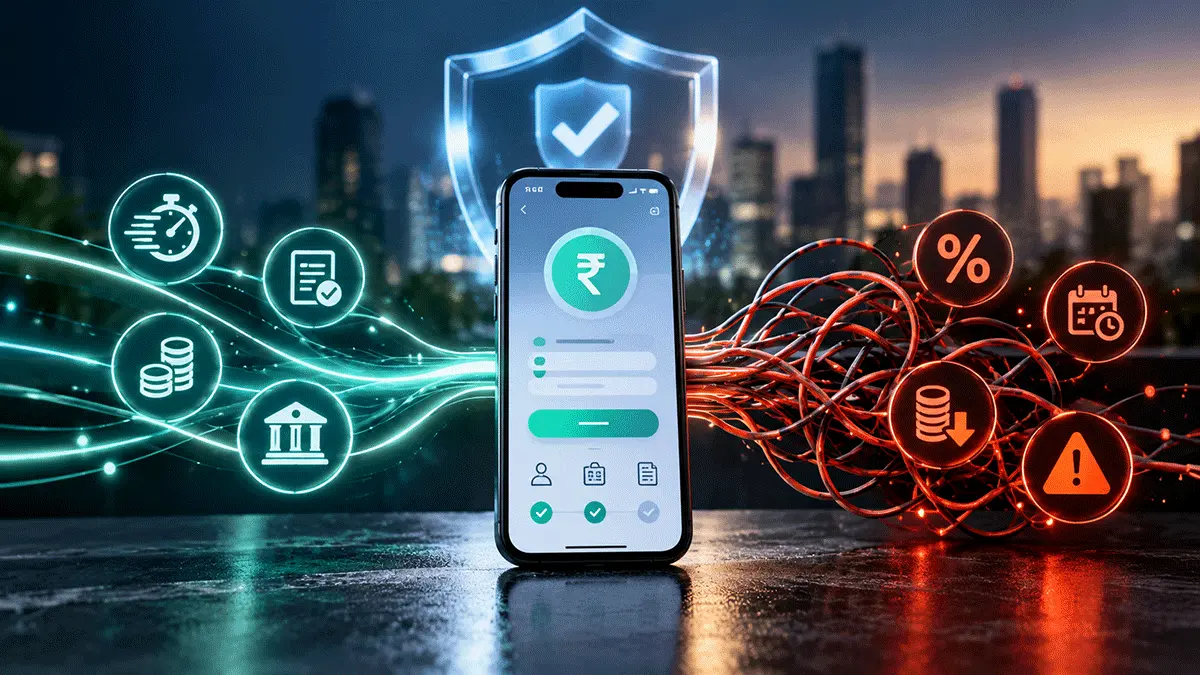
However, the speed of digital lending can sometimes hide a more complicated financial reality. A loan that appears affordable because of its small amount may carry significant processing charges, a very short repayment deadline or an expensive effective annual borrowing cost.
The problem becomes particularly serious when borrowers repeatedly take new short-term loans to repay existing ones.
Digital lending itself is not inherently unsafe or illegal. Banks, non-banking financial companies (NBFCs) and their authorised lending service providers can offer legitimate digital loans. The important question is whether the lender is identifiable, the loan terms are transparent and the borrower can realistically repay the debt.
This guide explains how digital lending apps and payday loans work in India, the risks associated with short-term borrowing, the protections available under RBI regulations and the steps borrowers can take when repayment becomes difficult.
What Are Digital Lending Apps?
A digital lending app (DLA) is a mobile application or online platform that facilitates some or all stages of the lending process through digital technology.
Depending on the platform, borrowers may be able to complete loan applications, identity verification, credit assessment, approval, disbursement and repayment without visiting a physical office.
Digital lending arrangements commonly involve three participants.
1. Regulated lender
The actual lender is generally a bank or an RBI-regulated NBFC. It provides the credit and remains responsible for complying with applicable regulatory requirements.
2. Lending Service Provider (LSP)
An LSP is a company engaged by a regulated lender to perform functions such as customer acquisition, loan processing, servicing or recovery. An LSP may operate the application through which customers apply for loans, but that does not necessarily mean the LSP itself is the lender.
3. Borrower
The borrower applies for the loan, agrees to the terms and becomes responsible for repayment under the loan agreement. An important distinction: A familiar app name does not automatically identify the company legally providing the loan. Borrowers should verify the actual lender’s name before accepting an offer.
What Is a Payday Loan?
A payday loan is generally understood as a small, short-term loan intended to cover immediate expenses until the borrower’s next salary or expected income. The expression payday loan is a common description of a borrowing arrangement rather than a separate RBI regulatory category. In India, similar products may be advertised as instant cash loans, salary advance loans, emergency loans or short-term personal loans.
Their characteristics may include:
- Relatively small loan amounts.
- Digital application and verification.
- Short repayment periods.
- Repayment through a single payment or a small number of instalments.
- Processing fees and interest that can be substantial relative to the amount borrowed.
Not every instant personal loan is a payday loan. A digital personal loan repayable over several months or years may have a very different cost and risk profile.
How Do Digital Payday Loans Work?
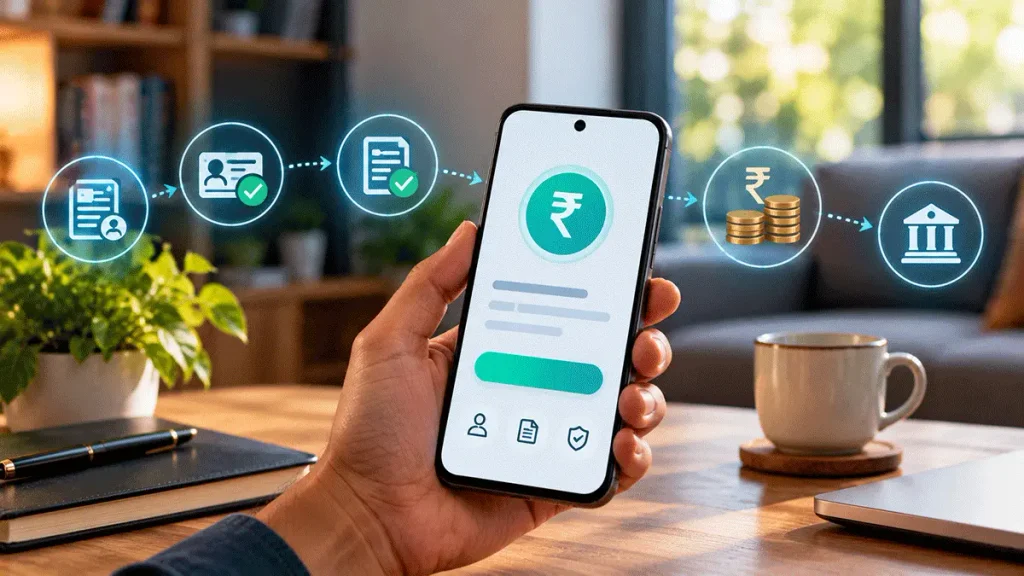
Although the exact process varies, a typical digital loan follows several stages.
Step 1: Application
The borrower installs an app or visits a lending website and enters details such as their name, mobile number, employment status, income and requested loan amount.
Step 2: Identity verification
The platform may complete KYC checks through approved processes and request supporting documentation. Borrowers should examine why particular information or device permissions are requested.
Step 3: Credit assessment
The lender assesses the applicant’s creditworthiness using information permitted under applicable rules. Depending on the lender, this may include income details, existing liabilities and credit bureau information.
Step 4: Loan offer
If eligible, the borrower receives an offer specifying the principal, interest, charges, repayment schedule and other contractual conditions. For regulated digital lending, borrowers should receive a Key Facts Statement before entering into the loan agreement.
Step 5: Disbursement
After acceptance and completion of the required formalities, the loan is ordinarily disbursed directly to the borrower’s bank account, subject to permitted regulatory exceptions.
Step 6: Repayment
The borrower repays according to the agreed schedule, potentially through UPI, bank transfer or an authorised repayment mandate. The borrower should verify that payments are directed to the legitimate lender through approved channels.
The Real Cost of a Short-Term Digital Loan
One of the biggest mistakes borrowers make is looking only at the amount offered and the repayment deadline. The actual borrowing cost includes interest and applicable fees.
Consider the following hypothetical example.
| Particulars | Amount |
|---|---|
| Loan principal | ₹10,000 |
| Loan period | 30 days |
| Interest charged | ₹300 |
| Processing fee | ₹500 |
| GST on processing fee (illustrative 18%) | ₹90 |
| Total borrowing cost | ₹890 |
| Net amount received if fees are deducted upfront | ₹9,410 |
| Total repayment at maturity | ₹10,300 |
Illustrative example only. The actual treatment of fees, GST, disbursement and repayment depends on the loan agreement.
The borrower receives ₹9,410 after the assumed upfront deductions but must repay ₹10,300 after 30 days. The effective cost is therefore much more significant than the ₹300 interest charge alone suggests. A simple 30-day cost comparison gives ₹890 ÷ ₹9,410, or approximately 9.46% of the net amount received.
This is not the same as the lender’s formally calculated Annual Percentage Rate (APR). APR uses prescribed annualised costing principles and should be checked in the lender’s Key Facts Statement.
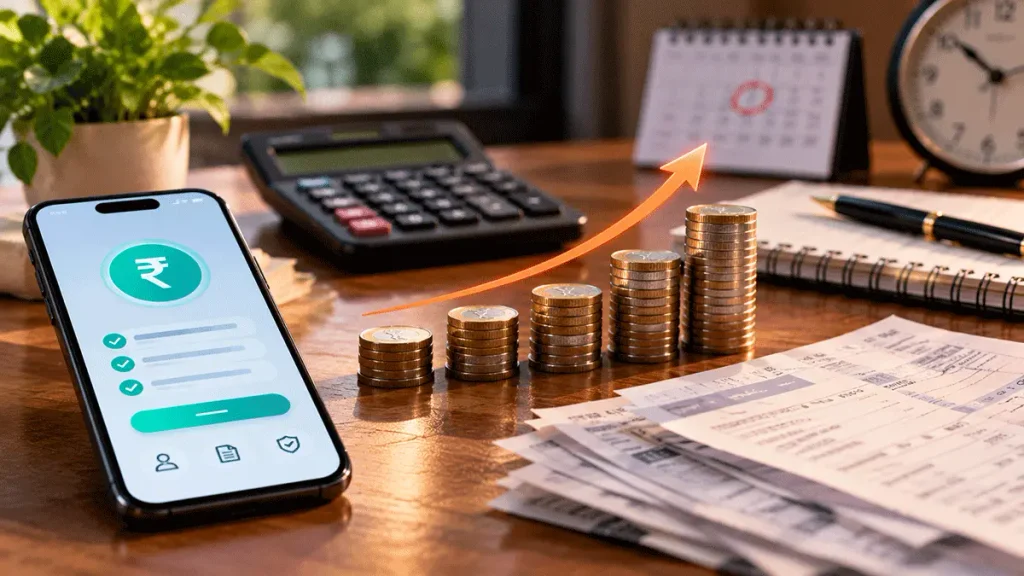
The lesson is straightforward: always compare the total amount you receive with the total amount you must repay, not just the advertised interest rate.
What Is APR and Why Does It Matter?
Annual Percentage Rate, or APR, expresses the borrowing cost on an annualised basis and incorporates applicable charges included under the regulatory framework. It helps borrowers compare offers that have different interest rates, processing fees and repayment periods.
For example, a short-term loan might advertise a relatively modest interest charge while imposing a sizeable upfront processing fee.
When those costs are considered together, the borrowing arrangement may be significantly more expensive than it initially appears. Under RBI’s digital lending framework, regulated lenders must disclose the APR and other required information in the Key Facts Statement.
Before accepting a loan, check:
- The amount actually disbursed.
- The amount and dates of repayment.
- The stated APR.
- Processing and other applicable fees.
- Late-payment and penal charges.
- Prepayment and cooling-off conditions.
Do not assume that a short repayment period makes a loan inexpensive.
Why Payday Loans Can Become a Debt Trap
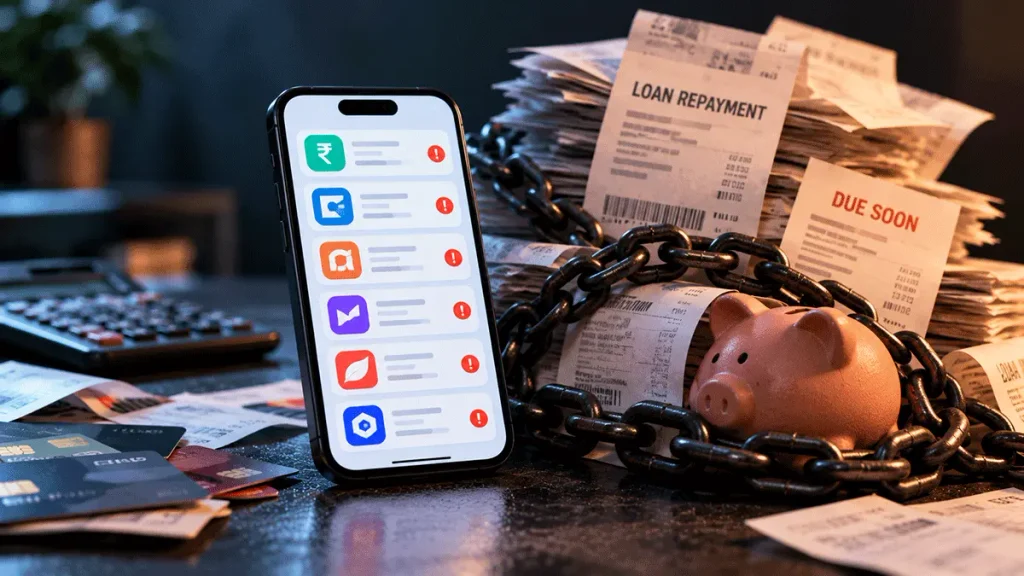
The main risk of repeated payday borrowing is not necessarily the size of any single loan. It is the pressure created by multiple repayment obligations falling due before the borrower has sufficient income.
Imagine someone earns ₹25,000 per month and takes a ₹10,000 short-term loan to meet an urgent expense. When repayment becomes due, the borrower still needs money for rent, groceries, electricity and transportation. If their salary is insufficient, they may take another loan to repay the first.
The second loan introduces additional charges and a new deadline. Over time, the borrower may begin using several applications, each with its own repayment date, fees and collection process.
This creates a cycle:
Unexpected expense → Short-term loan → Repayment pressure → Another loan → Additional charges → Greater repayment pressure.
The cycle can become especially difficult when income is irregular, employment is disrupted or household expenses increase unexpectedly.
Warning signs of a developing debt cycle
Repeated borrowing deserves immediate attention when:
- A new loan is taken mainly to repay an older loan.
- Total monthly repayments exceed realistically available income.
- Multiple loan applications are used simultaneously.
- Essential household expenses are being postponed to make repayments.
- The borrower no longer knows the exact outstanding balance across lenders.
- Collection calls and payment reminders are causing significant disruption.
At this stage, the priority should be understanding the full debt position and exploring affordable repayment arrangements, rather than automatically taking another expensive loan.
RBI Rules for Digital Lending in India
Digital lending by regulated entities is governed by RBI requirements, including the Reserve Bank of India (Digital Lending) Directions, 2025 and other applicable lending, disclosure and customer-protection instructions. These rules are intended to improve transparency, accountability, data protection and borrower treatment.
Key Facts Statement
A regulated lender must provide the required Key Facts Statement before the loan agreement is executed. The KFS is intended to make important financial terms understandable, including the cost of borrowing and repayment obligations. Borrowers should save a copy rather than relying solely on information displayed temporarily inside an app.
Clear identification of the lender
Borrowers should be able to identify the bank or NBFC legally providing the credit. A third-party app should not obscure the lender’s identity or its grievance redressal arrangements.
Direct loan disbursement and repayment
The digital lending framework generally requires loan disbursement and repayment to occur directly between the borrower’s bank account and the regulated lender’s bank account, subject to specified exceptions. A demand to repay into an unrelated individual’s account should be treated as a serious warning sign.
Transparent charges
The applicable borrowing costs must be properly disclosed. Charges cannot simply be introduced without regard to the contractual and regulatory disclosure requirements.
Cooling-off period
Regulated digital lending arrangements must provide a cooling-off or look-up mechanism under applicable RBI directions. This allows a borrower to exit a recently obtained digital loan within the specified period by paying the principal and proportionate APR, without a separate penalty for exercising that option. The precise period and conditions should be checked in the applicable KFS and current regulatory requirements.
Borrower data protection
Digital lenders and their service providers must comply with restrictions governing collection, use, storage and sharing of personal information. Borrowers should be particularly cautious about applications requesting access to contacts, call logs, photographs or other information unrelated to legitimate lending requirements.
Grievance redressal
Regulated lenders must provide appropriate grievance redressal arrangements for digital lending complaints. The use of a third-party lending platform does not automatically remove the regulated lender’s responsibility for its service provider’s conduct.
How to Check Whether a Digital Lending App Is Legitimate
A professional-looking interface or high app-store rating does not prove that a lender is authorised. Before borrowing, follow a verification process.
Identify the actual lender
Find the full legal name of the bank or NBFC providing the loan. Do not rely only on the app’s brand name.
Check the lender’s official website
Visit the bank or NBFC’s official website independently and verify whether it identifies the app or lending service provider as an authorised partner. RBI has also developed a public repository of digital lending apps based on information reported by regulated entities. Such listings assist verification but should not be mistaken for an RBI endorsement of a particular app.
Examine the loan agreement
A genuine loan offer should provide clear information about the lender, principal, repayment schedule, charges and grievance contact.
Review app permissions
Question requests for access to personal contacts, call logs or unrelated files.
Avoid suspicious installation links
Exercise caution with loan apps distributed through unsolicited SMS messages, social media advertisements or unknown download links. Even an app appearing in an official app store should be independently verified.
Are All Digital Lending Apps Legal?
No. But it is equally incorrect to assume that all digital lending apps are illegal. A legitimate app may be operated by a regulated lender or by a service provider acting on its behalf. At the same time, fraudulent or unauthorised operators may imitate legitimate lenders, misrepresent their regulatory status or engage in abusive collection practices.
The regulatory status of the actual lender and the nature of the lending arrangement matter more than the app’s appearance. A seven-day or 30-day repayment period does not, by itself, establish whether a loan is legal. Borrowers should verify the lending entity and contractual terms before drawing conclusions.
What Happens If You Cannot Repay a Digital Loan?
Missing a repayment deadline can have financial and credit-related consequences, but the consequences depend on the lender, agreement and applicable law. Potential outcomes include late-payment charges, continued collection efforts, reporting to credit information companies where applicable and attempts to recover legally enforceable dues.
Repeated defaults may affect access to future credit. However, financial difficulty does not give recovery agents permission to threaten, publicly humiliate or harass borrowers.
What borrowers should do
First, prepare a complete debt list.
Record the lender’s legal name, outstanding principal, charges, due dates and payment status.
Second, communicate in writing.
Explain the repayment difficulty to the lender through an official email address or grievance channel. Ask whether a revised repayment arrangement, extension or other hardship assistance is available.
Third, request a statement of account.
Check the amount claimed against the loan agreement, repayments already made and applicable charges.
Fourth, prioritise essential living expenses.
Create a realistic budget that accounts for food, housing, utilities and other necessary expenses.
Fifth, avoid borrowing from another expensive short-term lender merely to postpone the problem.
Such borrowing can increase total debt unless it forms part of a genuinely affordable, carefully evaluated restructuring arrangement. Lenders are not necessarily required to approve every extension or restructuring request. Borrowers should obtain any revised terms in writing.
Can Loan Recovery Agents Harass Borrowers?
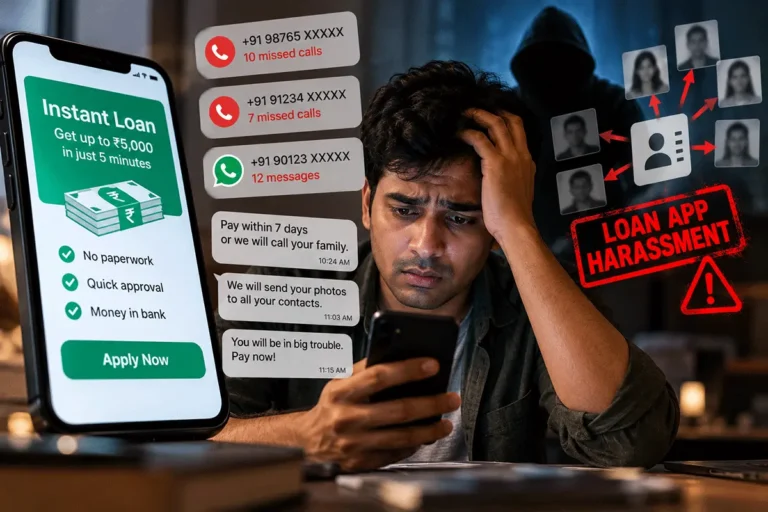
No. RBI’s rules governing regulated entities and their recovery agents prohibit intimidation, harassment and inappropriate collection behaviour. The RBI’s August 2022 instructions specifically address practices such as threatening or anonymous calls, persistent calling, public humiliation, intrusion into the privacy of family members and recovery calls before 8:00 a.m. or after 7:00 p.m.
These protections are important because repayment obligations and acceptable recovery conduct are separate matters. A borrower may still owe money, but that does not authorise abusive collection methods.
What to do if harassment occurs
Preserve relevant evidence, including call records, messages, emails, screenshots and the names or numbers used by collection representatives. Report the behaviour to the regulated lender’s grievance officer and request a written response.
If threats, impersonation, extortion, unlawful disclosure of personal information or other suspected crimes are involved, consider reporting the matter to the police or appropriate cybercrime authorities. Avoid publishing personal information about alleged agents or lenders on social media without verification.
How to Complain About a Digital Lending App
The appropriate complaint route depends on whether the matter concerns a regulated lender, a service provider or a suspected fraudulent operator.
Step 1: Contact the lender
Submit a written complaint to the bank or NBFC’s official grievance redressal channel. Include the loan reference, relevant dates, supporting evidence and the resolution requested.
Step 2: Escalate an unresolved regulated-lender complaint
For complaints falling within the RBI’s applicable ombudsman framework, borrowers generally need to approach the regulated entity first. Under the Reserve Bank – Integrated Ombudsman Scheme, 2026, an eligible complaint can be escalated when the lender has not responded within the applicable period or the borrower is dissatisfied with the response, subject to the scheme’s conditions.
The official complaint portal is https://cms.rbi.org.in/.
Not every lender or complaint is covered by the Ombudsman Scheme. Other regulatory grievance channels may apply.
Step 3: Report suspected cybercrime
For suspected online fraud, threats, impersonation or misuse of personal data, the National Cyber Crime Reporting Portal is available at https://cybercrime.gov.in/.
India’s cybercrime helpline is 1930, particularly relevant to reporting financial cyberfraud.
Step 4: Maintain evidence
Keep copies of the loan agreement, KFS, account statements, communications, repayment receipts and complaint acknowledgements. These documents can help establish what was agreed, what has been paid and what conduct is being disputed.
Safer Alternatives to Repeated Payday Borrowing
When a short-term cash shortage occurs, a new high-cost loan may not be the only available option. Depending on individual circumstances, alternatives worth examining include:
Employer salary advance
Some employers offer advances against earned or upcoming salary. Terms and availability vary.
Existing bank facilities
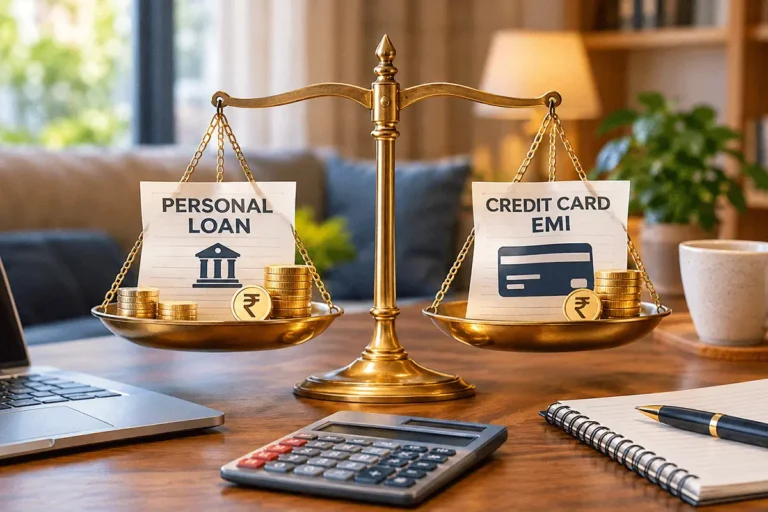
An eligible borrower may have access to a comparatively transparent overdraft or personal loan from their bank. However, the total cost and repayment affordability still need examination.
Negotiating payment dates
For certain expenses, it may be possible to request additional time from the service provider or creditor.
Emergency savings
Building even a modest emergency reserve over time can reduce dependence on expensive borrowing.
Reviewing monthly commitments
Reducing discretionary expenses and renegotiating manageable commitments may free up funds.
None of these options is universally suitable. The correct choice depends on income stability, total liabilities and the urgency of the expense.
How to Borrow Responsibly Through a Digital Lending App
Before accepting any digital loan, ask yourself five questions.
Do I know who the actual lender is?
Verify the bank or NBFC and the app’s relationship with it.
Do I understand the full cost?
Read the APR, fees, repayment schedule and Key Facts Statement.
Can I repay without taking another loan?
If repayment requires borrowing elsewhere, the proposed loan may not be affordable.
Am I comfortable with the information requested?
Review app permissions, privacy policies and consent requests.
Do I know where to complain?
Save the lender’s official customer support and grievance details.
A convenient borrowing process should never replace careful financial judgment.
The Bottom Line
Digital lending has made access to credit faster and more convenient for many Indians. When offered by identifiable, regulated lenders under transparent terms, it can serve legitimate financial needs. But convenience should not be confused with affordability.
Payday-style loans can become financially dangerous when high charges, short repayment periods and repeated borrowing combine to create a cycle of debt. Borrowers should understand the total borrowing cost, verify the lender, review the Key Facts Statement and avoid taking loans they cannot realistically repay.
Those already experiencing repayment difficulties should focus on documenting their obligations, communicating through official channels and seeking appropriate assistance rather than automatically accumulating more short-term debt.
The most important principle is simple: a loan should help solve a financial problem, not create a larger one.
Official references
- Reserve Bank of India — official regulations and financial education. RBI’s annual report confirms the introduction of the Digital Lending Directions, 2025.
- RBI Financial Awareness Messages — verification of lending apps, loan costs and data protection.
- RBI Complaint Management System — eligible complaints under the current ombudsman framework.
- National Cyber Crime Reporting Portal — reporting suspected cybercrime.
Important Disclaimer
This article is published by MoneyTrendy for general financial education and consumer awareness. It does not constitute personalised financial, legal or debt-management advice. Lending rules, complaint procedures and contractual obligations may vary according to the lender and circumstances. Readers should verify current requirements with the Reserve Bank of India, the relevant regulated lender or a qualified professional before making financial or legal decisions.
Editorial & financial note
MoneyTrendy content is educational and does not constitute personalised financial, investment, tax or legal advice.